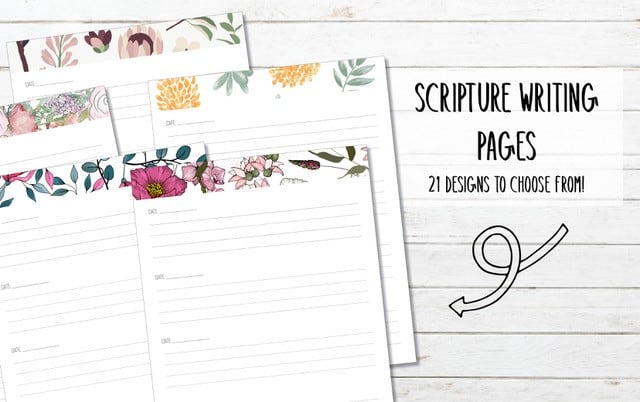
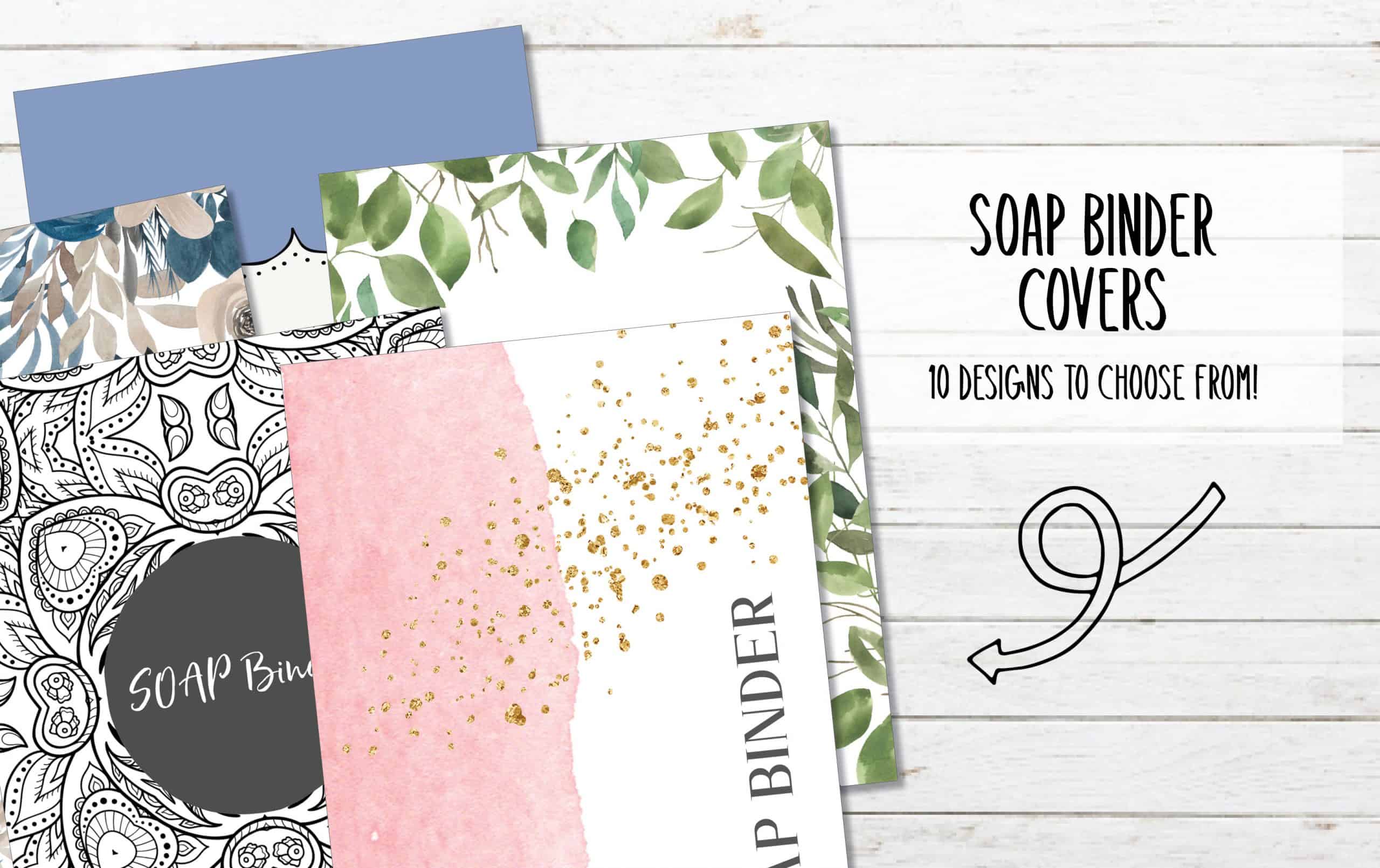
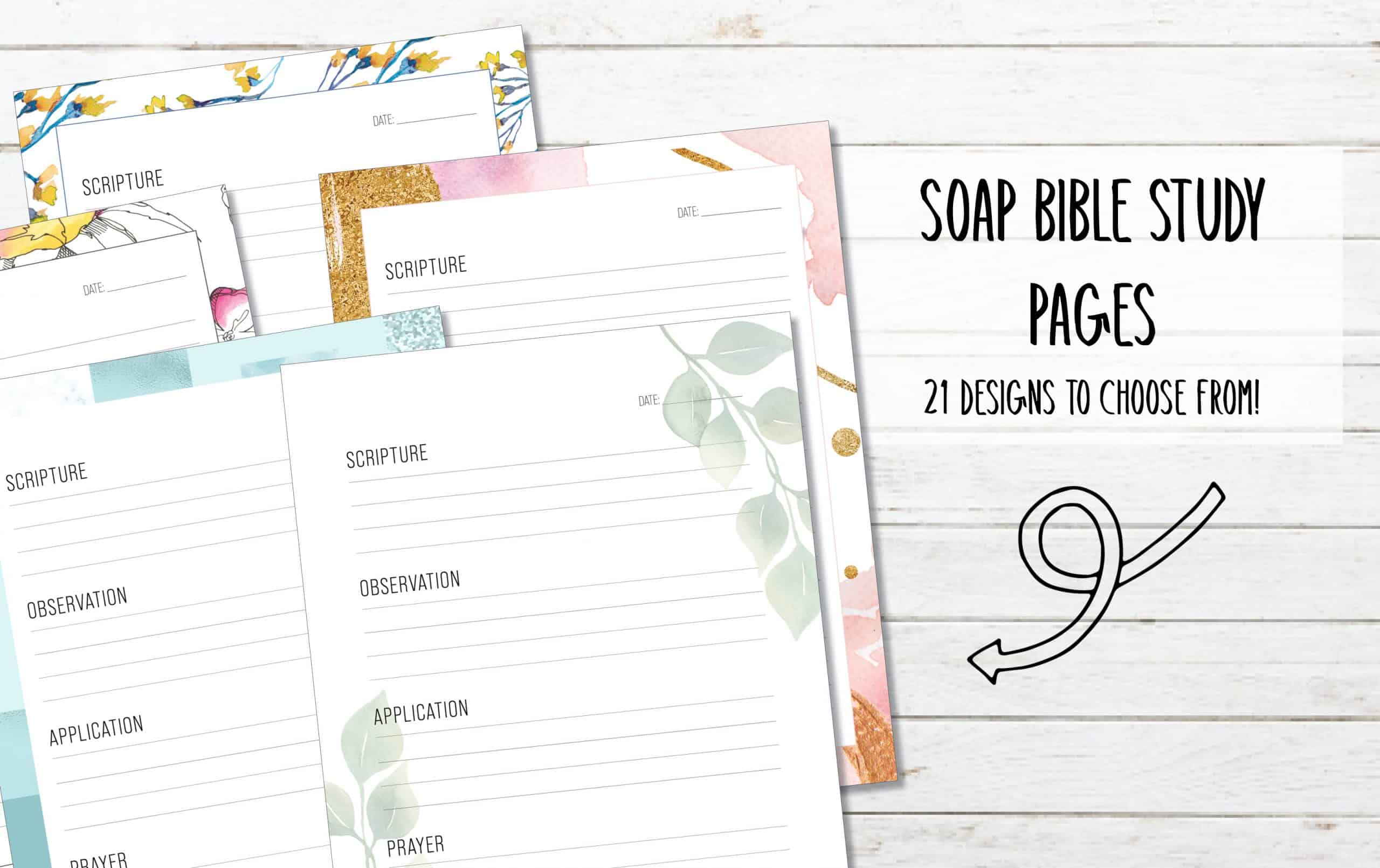
When it comes to studying the Bible the SOAP method is tried and true, and these beautifully designed SOAP Bible Study Page printables are a lovely way to record your observations and applications.
There are 21 different designs you can download and mix and match for your study times.
It can be hard to know how and where to start with studying the Bible.
There are resources out there, but they still don’t always lead to a deeper relationship with God, or a deeper understanding of His Word.
The SOAP method is a great way to get into God’s Word.
It’s an easy to remember acronym that can transform your Bible Study.
It stands for:
Scripture
Observation
Application
Prayer
Click here to find out more about the SOAP method of studying the Bible.
Creative Bible study can be a fun and different way of approaching Scripture which can open up God’s Word to us and help us to see it in a different light.
God’s Word is so exciting, but sometimes we can get in a rut with how we approach it, especially if we do things the same way all the time.
By mixing things up a bit, and putting some creativity into your Bible study, you may discover a fun and very relaxing way to spend time in God’s Word.
What is bible study?
Bible study is purely and simply studying and analysing the Bible.
Reading God’s Word, researching the meaning, truth, background and history in Scripture can be an enriching, and growing experience.
As Christians, we study the Bible, not just for the intellectual knowledge, but also to enhance and grow in our relationship with God, to learn more about Him, and to grow in our faith and Christian life and experience.
When it comes to creative Bible study the purpose is the same, but the methods can be different by adding some creativity, color and fun to enhance our experience.
Why can it feel like a chore?
There are times in our lives when our faith and our Bible study is exciting, and we are growing and learning and feeling so close to God.
But, it’s not always that way. There are other times when thinking about reading our Bible can feel like a chore, something we know we should do, but we don’t feel like it.
Often, particularly for those of us who have been Christians for a while, unfortunately our Bible study and Quiet Time can easily become dry, and dare I say it, boring.
David expressed it well in Psalm 63:1 where he said, “God, you are my God. I will earnestly seek you. My soul thirsts for you. My flesh longs for you, in a dry and weary land, where there is no water.”
We all go through these dry and challenging times where we long to find that joy and anticipation in approaching God’s Word, as we have done before.
Whether we are experiencing dry times, or we just want to mix things up and try something different, adding some creativity to our Bible study can be an enriching experience.
Creative ways to study the bible
Bringing creativity into our Bible study times can be fun and it can help to shake things up for us when things are dry.
It can add another dimension to our study and help us to engage in a different way with Scripture, and with God.
Some creative ways to study the Bible are:
Listening to Scripture
There are many benefits to listening to Scripture and it’s a great medium to use if you want to get an overview of the Bible, you can choose to listen on the go, listen as you go to sleep, or listen and read at the same time to maximise the impact.
When you listen and read at the same time it maximises your ability to learn and absorb as you are engaging more of your senses. Listening to Scripture can be very relaxing and listening to Scripture as you go to sleep may help you to not only sleep better but to allow God’s Word to soak into your subconscious as you sleep. It’s also a way of maximising your time, you can listen to God’s Word while you’re driving or cooking or on your morning walk.
Bible Journaling
Bible Journaling is where you write your thoughts, lessons learned, experiences and applications directly into your Bible. It is different from Scripture Journaling where you write into a separate journal, with Bible Journaling you record everything on the pages of your Bible.
You will need a special Bible Journaling Bible which provides spaces within the Scripture for you to write. You can decorate your Bible, using colors and stickers as you creatively reflect what God is showing you.
Draw Scripture
We are all created differently, with our unique gifts, talents, and styles. Some of us enjoy our creativity through words, while others express their creativity through visual arts. But you don’t have to be an artist to study the Bible through drawing. It’s all about connecting with God’s Word, meditating on it, and expressing your thoughts, feelings and emotion through creative art.
Using colors, shapes and forms, and images you can reflect your experience of God’s Word on paper. It will not only be a great reminder of what you have learned, but also the feelings and emotions attached to your experience of God’s Word.
Paint Scripture
Painting Scripture is another way of expressing what God is showing you through His Word. As you take the time to paint what you are thinking, seeing, and feeling, you have the opportunity to meditate and think deeply on what it is you have been reading.
Your painting can be big or small, it doesn’t have to be a masterpiece that hangs on the wall, but it could be. It’s all about connecting with God and His Word.
Color in Scripture
Again, this is one for the colored pencils. Coloring in is a very popular way of slowing down your pace and relaxing. Coloring in Scripture verses not only is relaxing but it creates a space where you can focus on God’s Word, on the verse you are coloring, and how that relates to you and your life.
If you would like to try Scripture coloring I have a heap of FREE bible verse coloring pages you can download and print out, check them out here!
Use Stickers
The use of stickers is also a fun way to study and mark up your Bible. They can be used on their own or you can use them along with Color Coding your Bible, Scripture Journaling and Bible Journaling.
Stickers can be used to highlight a verse or passage you want to draw your attention to. They can also be used in a similar way to color coding, by allocating a specific image or type of sticker to a theme you will be able to easily find references to those themes as you flick through your Bible and just look for those stickers that you have allocated to the topics.
They can also be used just for fun, to decorate your Bible, or to remind you of something you read that brought you joy.
Scripture Journaling
Scripture Journaling is not the same as Bible Journaling and it’s not the same as keeping a daily journal of the events of your life. It involves reading a passage of Scripture, writing out a verse, or words, that particularly stand out to you, writing out a truth that has meaning, writing any thoughts or questions you have about the passage and then writing out a prayer and application from what you have read.
Choosing a passage of Scripture and writing it out is a great way to slow down and focus on what you are reading and writing.
With so much of our writing and our life revolving around computers we don’t really spend as much time handwriting any more. Instead of writing a card or a letter we send an email.
But there is a lot to be said about the act of writing, and in particular, writing out Scripture. It helps you to stay focussed on the words in front of you, it helps you to engage more as you think more deeply about them and engage your senses in the activity, the slower pace of it helps you to see things you may have otherwise overlooked, and it can create a space to allow you to internalize and learn more of what you are studying.
Color Coding Your Bible
Color coding your Bible is a great, fun way to engage with Scripture. You can use colored pencils, felt pens or highlighters to color your Bible.
Choose a topic, or a theme, or a person that you would like to follow in Scripture and allocate a color to it. As you come across verses that relate to whatever it is you have chosen to study you color in the verse in the allocated color.
The benefits of this are that it enables you to think more deeply about what you are reading, and also acts as a good resource later on, if you want to look something up or find something that you have previously read, you can go back and follow the color theme that you have created.
The Bible is an amazing book, and there are so many truths and promises in it that we can learn from.
But studying the Bible can be quite daunting. How do I do it? Where do I start?
The topical approach to studying can be a great way to get into God’s Word.
You choose the topic you want to study, learn what it means, whether it’s a word, or a phrase, and explore how it is weaved throughout the entire Word of God. It can be a broad way of studying a particular theme or word, as an overview, or, you can go more deeply into the subject.
For example, if you chose ‘Grace’ as your topic you would learn what God’s grace means and how God extends His grace throughout the Bible. You would be able to follow the topic through to see how God’s grace was there from the beginning, from the Garden of Eden, through the history of the Children of Israel, through to Christ’s coming, and the birth and early years of the church.
It’s always a great place to start with prayer. Firstly, to pray and ask the Lord what topic He would like to teach you, and then before each study spend a little time in prayer asking the Lord to show you His truth and what He wants to reveal to you along the way. I like to pray Psalm 119:18, “Open my eyes, that I may see wondrous things out of your law”.
Choose a Topic
Prayerfully choose your topic. The Bible is a never ending resource and there are so many topics you can choose. The topic could be a word, or a phrase, or even a person. You may want to follow a theme that your pastor is speaking on at church, or in Bible Study, or it may be something more personal, like an issue you are struggling with, such as anxiety or fear.
Look Up References
Start looking up, and writing down, references for your topic. You can use a Bible concordance or Bible dictionary to help you. There are plenty of online references you can use also, just type your word or phrase into the search engine and see what comes up.
You will most likely have a very long list by this stage so once you have your list sort through which of the verses you want to use for your study
Read and Observe
Now you have your verses it’s time to start your study.
You don’t need to rush through the process.
You may want to complete the study in an allocated time, such as a morning or an afternoon, or, alternatively, you may want to take longer with it, working your way through one verse or one passage at a time, using a different one each day as part of your quiet time or devotional time so you can really allow God’s Word to soak into you over a period of time.
As you read make observations, ask questions, look for principles.
Ask who, what, when, where and why of the verses.
What is the main point of the passage?
What does the passage tell me about God/myself?
Are there any instructions in the passage?
Write down your answers and observations.
Conclude and Apply
James 1:22 instructs us to be doers of the Word not just hearers.
Once you have read the passage of Scripture, asked yourself questions about it, and made some observations it’s then time to make it personal.
We rob ourselves if we approach Scripture from a purely academic level and not make it personal and allow it to transform our lives.
What is God saying to you, what is He teaching you through these verses? Is there a truth about God that you have learned? Is there an action He wants you to take? Is there something He wants you to change?
This part can take a little time as you reflect, and pray, and ask God to show you the truth of what He wants to teach you.
It’s a good idea to write down your application, it helps to clarify your thoughts and any actions you wish to take, and it also serves as a prompt and a reminder as you reflect back later.
Share What You Have Learned
Not everyone is comfortable with this, but it can be a great thing to share with a friend, a partner, or even on social media, the lessons God is teaching you. It’s not only good for you, to reinforce those lessons, but it can be an encouragement to others.
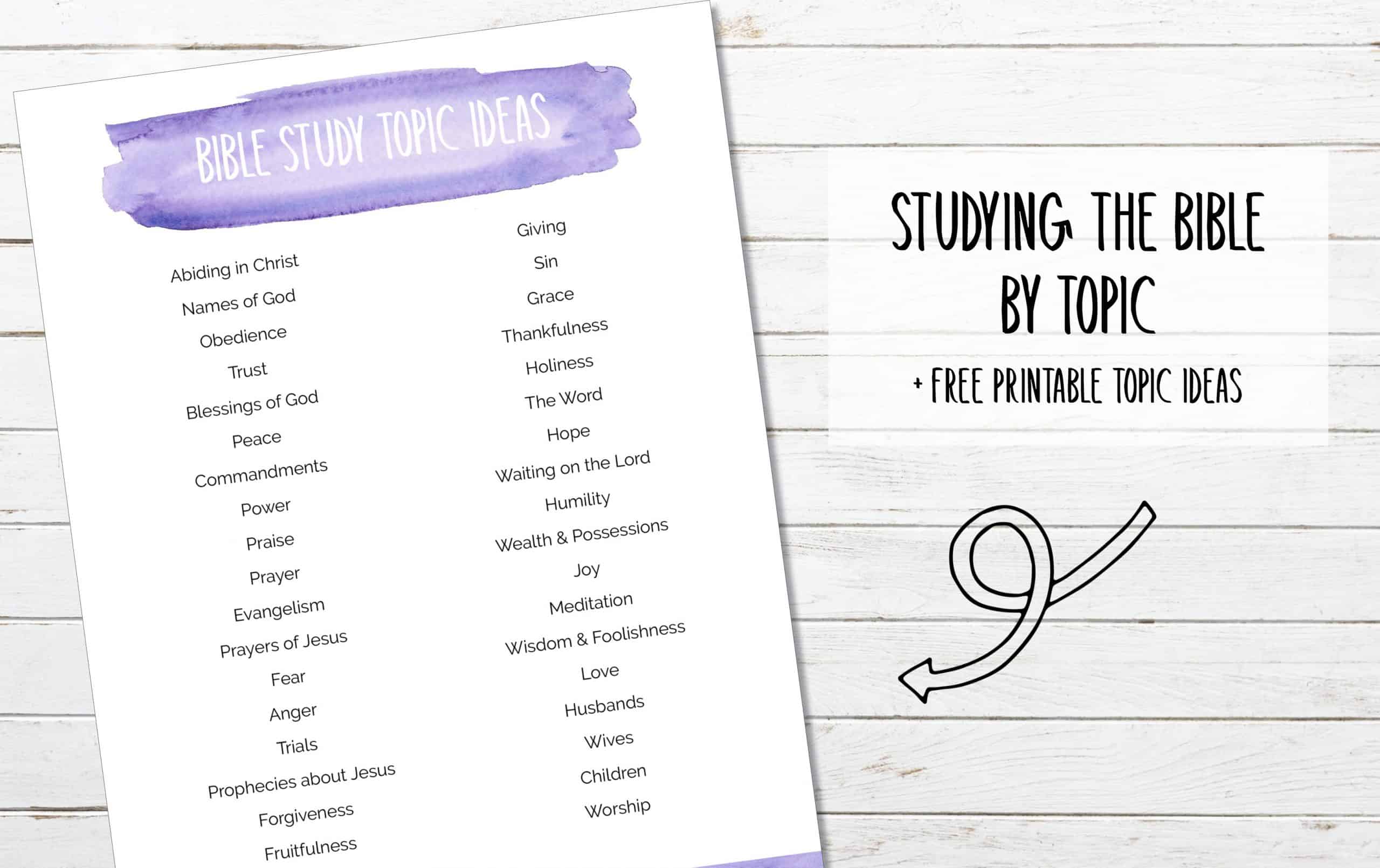
Some Suggested Topics for Study
Abiding in Christ
Names of God
Obedience
Trust
Blessings of God
Peace
Commandments
Power
Praise
Prayer
Evangelism
Prayers of Jesus
Fear
Anger
Trials
Prophecies about Jesus
Forgiveness
Fruitfulness
Righteousness
Giving
Sin
Grace
Thankfulness
Holiness
The Word
Hope
Waiting on the Lord
Humility
Wealth & Possessions
Joy
Meditation
Wisdom & Foolishness
Love
Husbands
Wives
Children
Worship
It’s an exciting journey as you start delving into Scripture, and God never ceases to surprise and amaze me at what He teaches me.
Have you tried Scripture Journaling? It’s as a great way to study God’s Word and to do a Topical Bible Study.
The SOAP method is also a good one to use for Bible study and devotional times.
Christmas can be a wonderful and fun time of the year but it’s easy to get caught up in the busyness that goes along with the season.
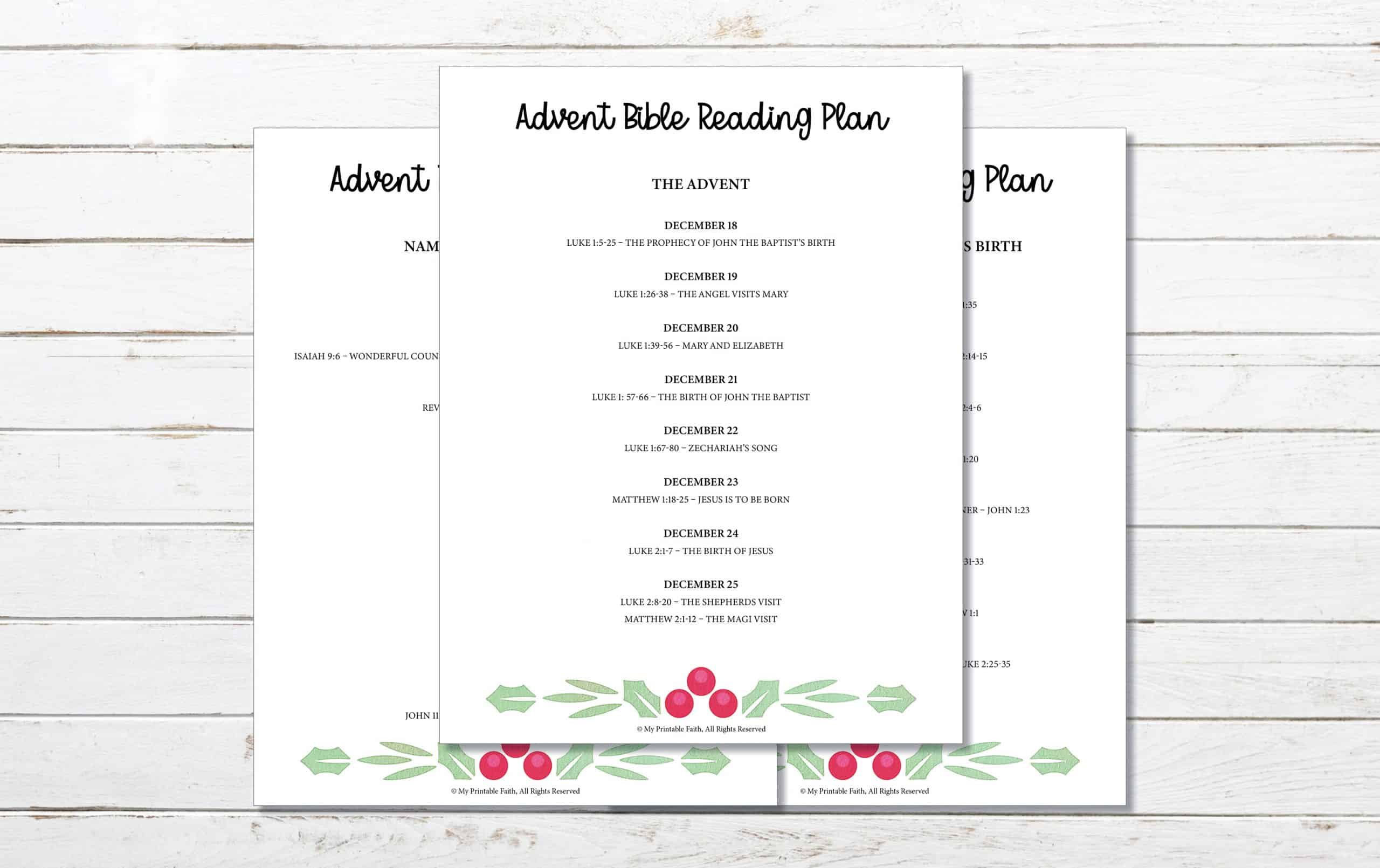
These advent bible readings is a great way to take some time out to focus on the scriptures and the real meaning of the Christmas season.
It starts on the 1st of December and goes all the way through till Christmas Day on the 25th and includes scriptures from both the Old and New Testaments going through not just the birth of Jesus but the prophecies that led up to it. I have also included the names of Jesus to reflect on during this time as we think about the birth of Jesus and what that means to us.
You can use the reading plan in your daily devotional time, during your family devotional time, or for your Scripture Journaling. Why not pop it into your Bible Study Basket for easy access!
PROPHECIES ABOUT JESUS AND HIS BIRTH
DECEMBER 1
Isaiah 7:14 – A Virgin Will Conceive – Luke 1:35
DECEMBER 2
Hosea 11:1 – Called Out of Egypt – Matthew 2:14-15
DECEMBER 3
Micah 5:2 – Born in Bethlehem – Matthew 2:4-6
DECEMBER 4
Genesis 3:15 – Born of a Woman – Matthew 1:20
DECEMBER 5
Isaiah 40:3-4 – John the Baptist Will Be the Forerunner – John 1:23
DECEMBER 6
Daniel 7:13-14 – Everlasting Throne – Luke 1:31-33
DECEMBER 7
2 Samuel 7:12-13 – The Family Line – Matthew 1:1
DECEMBER 8
Isaiah 42:1-8 – Simeon Recognizes the Messiah – Luke 2:25-35
NAMES AND TITLES OF JESUS
DECEMBER 9
Isaiah 7:14 – Immanuel
DECEMBER 10
Isaiah 9:6 – Wonderful Counsellor, Mighty God, Everlasting Father, Prince of Peace
DECEMBER 11
Revelation 22:13 – Alpha and Omega
DECEMBER 12
John 1:41 – Messiah
DECEMBER 13
Luke 2:11 – Savior
DECEMBER 14
Mark 1:10-11 – Son of God
DECEMBER 15
Luke 19:10 – The Son of Man
DECEMBER 16
John 1:1 – The Word
DECEMBER 17
John 11:25 – The Resurrection and the LIfe
THE ADVENT
DECEMBER 18
Luke 1:5-25 – The Prophecy of John the Baptist’s Birth
DECEMBER 19
Luke 1:26-38 – The Angel Visits Mary
DECEMBER 20
Luke 1:39-56 – Mary and Elizabeth
DECEMBER 21
Luke 1: 57-66 – The Birth of John the Baptist
DECEMBER 22
Luke 1:67-80 – Zechariah’s Song
DECEMBER 23
Matthew 1:18-25 – Jesus is to Be Born
DECEMBER 24
Luke 2:1-7 – The Birth of Jesus
DECEMBER 25
Luke 2:8-20 – The Shepherds Visit
Matthew 2:1-12 – The Magi Visit
Scripture shows us that God’s plans were in place from the beginning. He knew our need, our relationship with the Father had been broken through sin, and in His love, grace, and mercy, He provided a way to have that relationship restored. He sent His own Son, Jesus, to make a way for us.
He said to them, “This is what I told you, while I was still with you, that all things which are written in the law of Moses, the prophets, and the psalms, concerning me must be fulfilled.”
Hi, I'm Steph! I want to equip you with faith resources to encourage a love of Gods word in your life.
DISCLAIMER
Some of the links on this website are affiliate links of which My Printable Faith receives a small commission from sales of certain items, but the price is the same for you. As an Amazon Associate I earn from qualifying purchases.
TERMS OF USE
All our printables are for personal or free ministry use only.
If you wish to share our printables on your website, you may do so with a do-follow backlink to the blog page and credit. You may not share the files or images directly on your site.