Some letters carry a particular sense of urgency. In 2 Peter, the writer speaks of his approaching death and his desire for believers to remember the truth after he is gone (2 Peter 1:14–15). That concern shapes all three chapters: remember what you have received, recognise false teaching, and keep looking forward to Christ’s return.
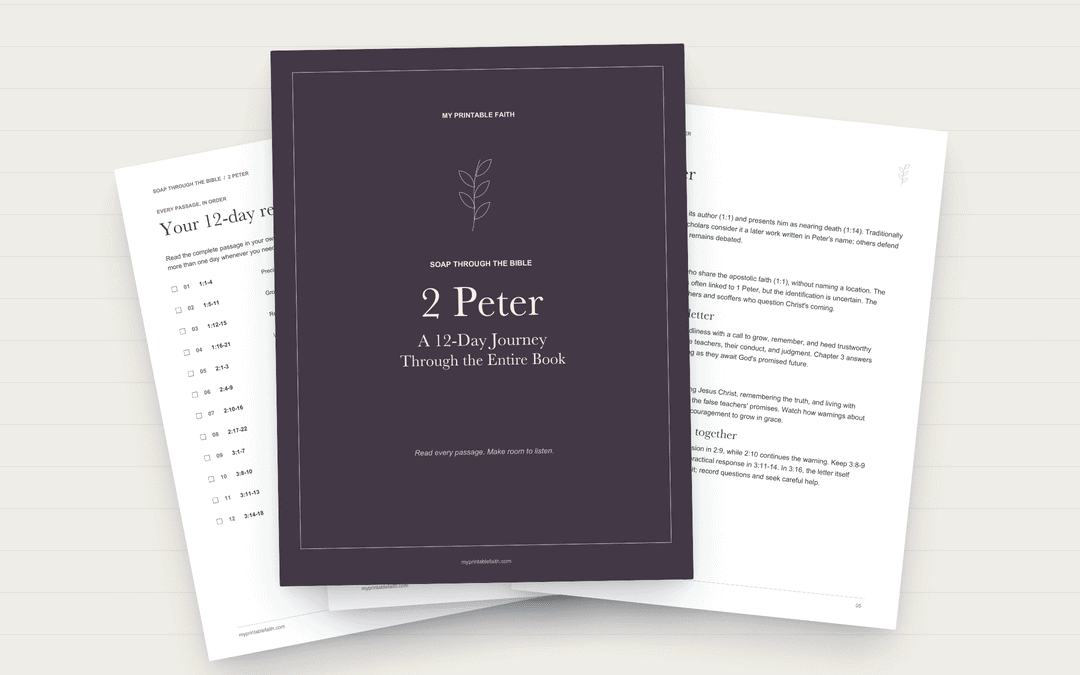
SOAP Through the Bible: 2 Peter is a free 12-day Bible study journal that guides you through the entire letter. Using the SOAP method, it gives you space to read carefully, consider each passage in context, and respond through writing and prayer.
A Letter Written to Be Remembered
Remembering is a central theme in 2 Peter. Peter explains that he will continue reminding his readers of the truth, “though ye know them, and be established in the present truth” (2 Peter 1:12, KJV). Knowing something once doesn’t mean we never need to hear it again.
Chapter 1 begins with God’s provision for a life of faith and godliness, then calls believers to grow. It also points to the apostles’ eyewitness testimony and the trustworthiness of prophecy. Chapter 2 warns about false teachers, describing their conduct, influence, and judgment. Chapter 3 addresses those who question Christ’s return and calls believers to live holy lives as they wait.
Near the close comes this familiar instruction: “grow in grace, and in the knowledge of our Lord and Saviour Jesus Christ” (2 Peter 3:18, KJV).
Reading the whole letter helps you see how these themes connect. Growth, discernment, remembrance, and hope belong together.
This journal is part of the SOAP Through the Bible series, alongside the Ephesians and James studies. Each journal encourages you to read passages in context and notice connections that are easy to miss when reading individual verses.
What’s Inside
This 33-page printable journal includes:
A welcome and orientation section explaining the journal’s approach and how to use the SOAP method.
An “About 2 Peter” background page introducing the authorship debate, what the letter tells us about its readers, and the main themes of its three chapters.
A complete 12-day reading plan with a checkbox for each session, beginning at 2 Peter 1:1–4 and ending at 3:14–18.
12 two-page study sessions. The first page includes the passage reference, a short focus prompt, and space for Scripture (S) and Observation (O). The second provides lined space for Application (A) and Prayer (P).
Three closing reflection pages: “Looking Back at 2 Peter,” “What I Learned About God,” and “Truths I Want to Remember.”
The writing pages have plain white backgrounds for easy home printing. The reading plan covers every verse of 2 Peter, with each assigned passage read in your own Bible.
Who This Is For
With three chapters divided into twelve sessions, this journal offers a manageable way to study a complete biblical book. Some passages need careful thought, but you don’t need to understand everything before you begin.
It’s a useful study for anyone wanting to explore what 2 Peter teaches about spiritual growth, false teaching, and the promise of Christ’s return. The questions and writing spaces encourage you to consider both what the passage means and how it should shape your life.
You can work through it on your own or use your entries as a starting point for discussion with a friend or small group.
How to Use It
Begin by reading the entire passage assigned for the day in your own Bible. The journal provides the reference and a short focus prompt; the biblical text itself is not printed in the journal.
Then work through the four parts of SOAP:
Scripture: Choose a verse or short excerpt that stood out. Copy it into the Scripture space and include its reference.
Observation: Consider what the passage says. Notice repeated words, contrasts, connections, and how it relates to the surrounding verses.
Application: Identify one specific way the passage might shape your beliefs, attitudes, or actions.
Prayer: Respond to God with praise, confession, thanksgiving, or a request for help putting what you’ve learned into practice.
Scripture and Observation are on the first page of each session. Application and Prayer are on the second. You don’t need to fill every line; give yourself room to think carefully and respond honestly.
Some passages in 2 Peter invite closer study, particularly the warnings in chapter 2. In 3:16, Peter also acknowledges that some things in Paul’s letters are difficult to understand. The journal encourages you to bring difficult questions to a trusted Bible teacher.
The twelve days are a sequence, not a deadline. If a passage needs another sitting, take the time you need. When you finish, the closing reflection pages help you gather what you’ve learned about God and identify the truths you want to remember.
Hope While We Wait
One of the letter’s strongest encouragements concerns God’s patience. Peter describes the Lord as “not willing that any should perish, but that all should come to repentance” (2 Peter 3:9, KJV).
That patience sits alongside the promise of Christ’s coming and the call to holy living. As you read, consider how those truths belong together: what does it mean to trust God’s timing and live faithfully while you wait?
The journal gives you space to return to questions like this, looking at each verse within the passage around it.
Download your free SOAP Through the Bible: 2 Peter journal below and begin Day 1 whenever you’re ready.
Some books of the Bible are easy to skim and hard to actually live. James is one of them. It’s short, practical, and often quoted a verse at a time — “count it all joy,” “faith without works is dead,” “be ye doers of the word” — but read in fragments, it’s easy to miss how tightly James ties those lines together into one sustained call to let your faith show up in ordinary life.
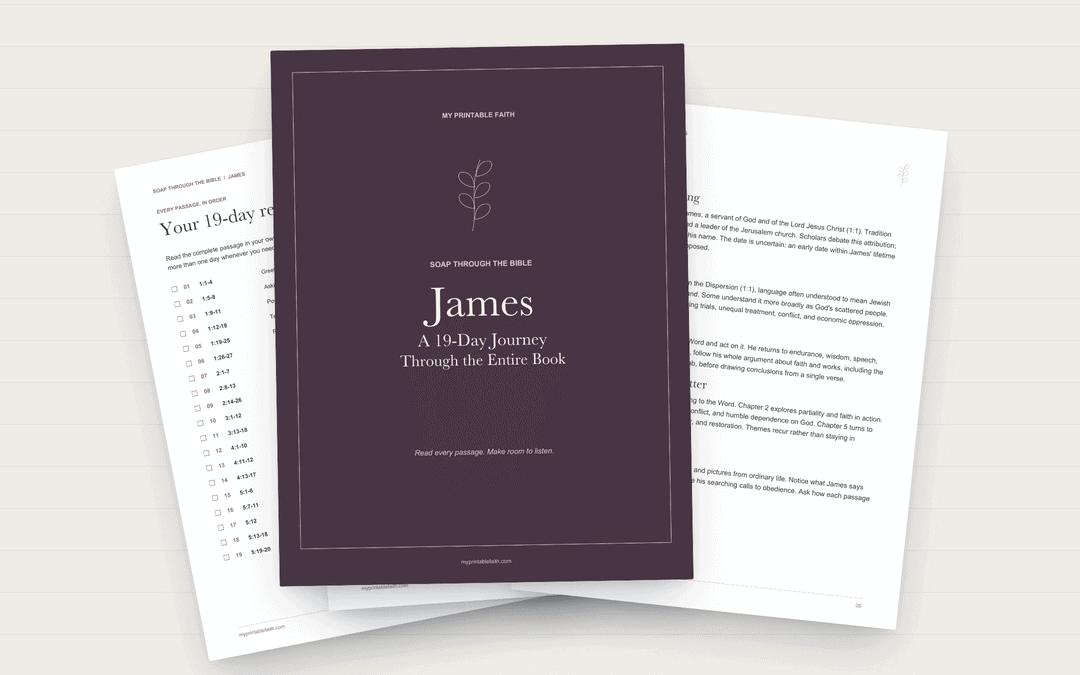
SOAP Through the Bible: James is a free 19-day Bible study journal that walks you through all five chapters of James in order, using the SOAP method to slow down and let the whole letter speak for itself — not just its most quotable lines.
A Letter Written for the Hard Days
James doesn’t open gently. His very first instruction is to “count it all joy when ye fall into divers temptations; knowing this, that the trying of your faith worketh patience” (James 1:2–3). From there he moves through wisdom, wealth, speech, conflict, patience, and prayer, always circling back to the same question: does what you believe actually shape what you do?
That question comes to a head in James 2:17: “Even so faith, if it hath not works, is dead, being alone.” It’s one of the most direct verses in the New Testament, and it lands very differently once you’ve read the three chapters that build up to it than it does as a stand-alone quote. That’s the whole point of reading a letter in order rather than in pieces.
This journal is the second entry in the SOAP Through the Bible series (following Ephesians), built around the same conviction: a whole book, read slowly and completely, teaches you things a scattered devotional never will.
What’s Inside
This is a 47-page printable journal, structured the same simple way as every study in this series:
A welcome and orientation section explaining the journal’s approach and the SOAP method, so you know exactly what to do with each of the four letters before you begin.
An “About James” background page, covering who wrote the letter, who its first readers were, and how its five chapters move — from trials and wisdom in chapter 1, to partiality and faith in action in chapter 2, speech and conflict in chapters 3–4, and patience, prayer, and restoration in chapter 5.
A complete 19-day reading plan, listing every passage in order with a checkbox to tick off, from James 1:1–4 through to the closing call in 5:19–20 to restore someone who has wandered.
19 daily study spreads — two pages each. The first carries the day’s passage reference, a short focus question, and room for your Scripture selection (S) and Observation (O). The second holds Application (A) and Prayer (P), with generous lined space for both.
Three closing reflection pages — “Looking Back at James,” “What I Learned About God,” and “Truths I Want to Remember” — so what you’ve read and written throughout the study gets gathered into something worth keeping, rather than left scattered across nineteen separate days.
As with every printable in this series, the writing pages are plain white for easy home printing, and every reading is the complete assigned passage — nothing summarised or skipped on your behalf.
Who This Is For
James is often recommended to newer believers because it’s short and direct, but it rewards a careful reader at any stage of faith — especially anyone who wants their Bible study to move past good intentions and into “doers of the word, and not hearers only” (James 1:22). If you’ve ever finished a devotional feeling encouraged but unsure what to actually do differently, this letter — and this format — is built for you.
It also works well for anyone studying with others. Because each day’s reading is short (some passages are as brief as two or three verses), it’s easy to bring a completed day’s SOAP entry to a small group or accountability conversation without needing to catch anyone up on a long backstory.
How to Use It
Read the entire passage assigned for the day in your own Bible first — the journal gives you the reference and a short focus question to read with, but the reading itself happens in Scripture, not on the page. Once you’ve read the whole section, choose a verse or short excerpt that stood out and copy it into the Scripture (S) space with its reference. Then work through Observation (O): what is James actually saying, who is he addressing, and how does this passage connect to what came just before it?
On the facing page, move to Application (A) — one specific way this truth might shape a belief or a habit — and close with Prayer (P), bringing God your honest response: praise, confession, a request, or a question you’re still sitting with. You don’t need to fill every line for the day to count.
Because James keeps returning to the same handful of themes — trials, wisdom, speech, humility, patience — the reading plan is designed to be read as a sequence rather than rushed through on a deadline. If a passage needs a second sitting before you’re ready to respond, the journal is built to accommodate that. When you reach the end, the three closing pages help you gather the letter’s repeated ideas, notice what you’ve learned about God’s character, and name the truths and passages you want to keep returning to.
A Gentle Invitation
James doesn’t ask for perfect follow-through — he asks for an honest, active faith, worked out one ordinary decision at a time. That’s exactly the kind of reading this journal makes room for: not a quick pass through a few favourite verses, but nineteen unhurried sittings with the whole letter, from its opening word about trials to its closing call to restore someone who has wandered.
Grab your free copy of SOAP Through the Bible: James on the blog and begin at Day 1 whenever you’re ready.
Have you ever finished a devotional and realised, a few weeks later, that you can’t remember which verses it covered? Reading a whole book of the Bible helps you see how its ideas connect—how a promise prepares the way for an instruction, or how a familiar verse fits into a larger message.
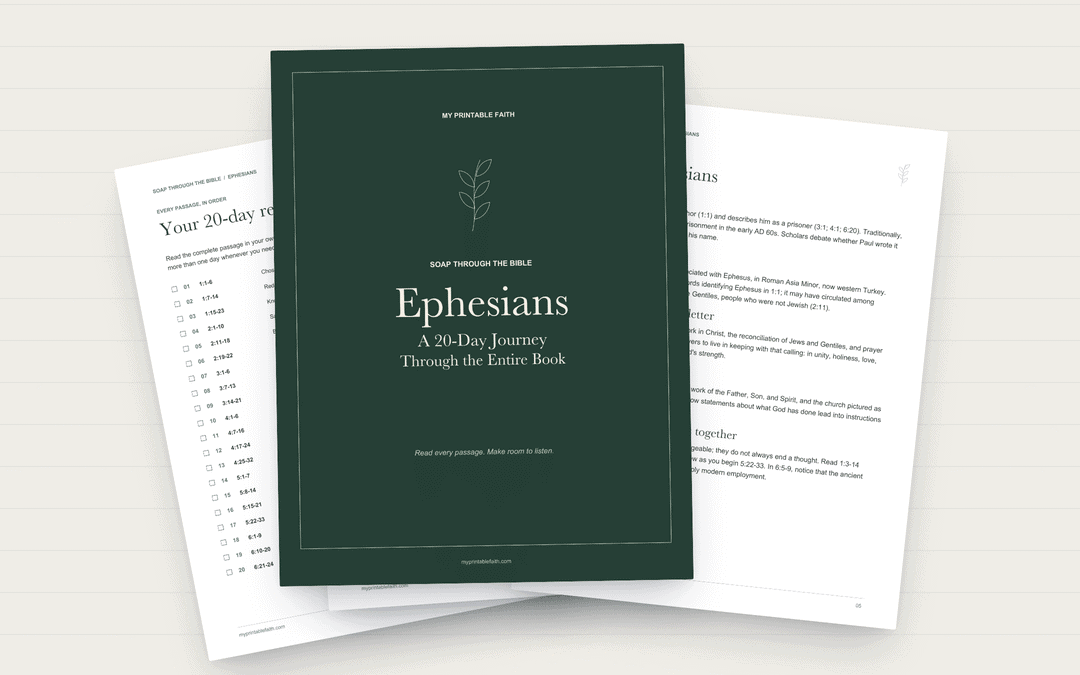
SOAP Through the Bible: Ephesians is a free 20-day Bible study journal that guides you through the entire letter to the Ephesians—all six chapters, from start to finish. It uses the SOAP method to help you slow down, observe what Scripture says, and respond thoughtfully.
Why Study a Whole Book of the Bible?
Ephesians gives us a rich picture of what God has done for us in Christ: we are chosen, redeemed, made alive, and brought near. The first three chapters focus on these truths; chapters four through six develop the practical response through teaching about unity, honesty, love, relationships, and standing firm in faith.
Reading the letter in order helps you see how those instructions grow out of God’s saving work. Each passage contributes to the message of the whole.
Paul prayed that believers would be “rooted and grounded in love” and able to comprehend “the breadth, and length, and depth, and height,” going on to speak of knowing Christ’s love and being filled with all the fullness of God (Ephesians 3:17–19, KJV). Staying with the letter gives you room to explore how these truths connect.
This printable is part of the SOAP Through the Bible series, created to help you read every verse of a biblical book and respond to it honestly.
What’s Inside?
This 49-page printable journal offers a simple, repeatable study rhythm:
A welcome and orientation section explaining how to use the journal, with a separate page introducing each step of the SOAP method.
An “About Ephesians” background page introducing the letter’s authorship, first readers, main themes, and structure.
A complete 20-day reading plan covering every passage in order, from Ephesians 1:1 to 6:24, with checkboxes to track your progress.
20 two-page study sessions. The first page includes the passage reference, a short focus prompt, and lined space for Scripture and Observation. The second provides space for Application and Prayer.
Three closing reflection pages: “Looking Back at Ephesians,” “What I Learned About God,” and “Truths I Want to Remember.”
Every writing page has a white background for home printing. The reading plan covers every verse of Ephesians, with prompts to help you explore each passage in your own Bible.
Who Is This Journal For?
This journal is for anyone who wants a clear structure for studying a whole book of the Bible. You might be new to SOAP journaling, returning to Bible study after a break, or looking for a fresh way to work through Ephesians.
You can use it on your own or alongside a small group studying the same passages.
The readings are manageable, with some as brief as four verses. The day numbers provide a sequence rather than a deadline, so you can move at a pace that gives you time to think. If one passage takes two or three sittings, that’s fine.
How to Use the Ephesians SOAP Journal
Begin by asking God to help you understand His Word. Then read the entire passage assigned for the day in your own Bible. The journal supplies the reference and a focus prompt to guide your attention.
Once you’ve read the whole passage, work through the four SOAP steps:
S — Scripture
Choose one verse or a short section that stood out to you. Copy it into the Scripture space and include its reference. Keep the surrounding passage in mind as you write.
O — Observation
Notice what the passage says. Who is being addressed? What words or ideas are repeated? Are there contrasts, commands, promises, or reasons to pay attention to? How does this section connect with what came before?
You can record questions here too.
A — Application
Consider how the passage should shape what you believe or how you live. You might identify a truth to trust, a sin to confess, or one practical step of obedience.
Let your response grow from the meaning of the passage.
P — Prayer
Respond to God in praise, thanksgiving, confession, or a request for help. Pray about what you’ve learned and anything you’re still trying to understand.
You don’t need to fill every line. A thoughtful observation or a short, specific prayer can be a meaningful response to Scripture.
After completing the 20 readings, use the closing pages to reflect on the whole letter. Summarise its message, gather what you’ve learned about the Father, the Son, and the Holy Spirit, and choose truths you want to remember.
As Paul wrote to Timothy:
“All scripture is given by inspiration of God, and is profitable for doctrine, for reproof, for correction, for instruction in righteousness: That the man of God may be perfect, throughly furnished unto all good works.”
— 2 Timothy 3:16–17, KJV
A steady study of Ephesians gives you time to receive that instruction and consider how to put it into practice.
Download Your Free Ephesians Bible Study Journal
You don’t need an established Bible study routine to begin. Bring your Bible, a pen, and a willingness to read carefully.
Ephesians opens with praise for God’s spiritual blessings in Christ and closes with blessings of peace, love, faith, and grace. This journal gives you space to explore the whole letter, one passage at a time.
Download your free SOAP Through the Bible: Ephesians journal below and begin with Day 1 whenever you’re ready.
Can we be honest for a second? Family devotion time sounds lovely in theory. In practice, by the time dinner’s on the table, everyone’s tired, someone’s still finishing homework in their head, and the idea of pulling out a whole devotional book and reading a full page feels like one more thing nobody has the energy for. So it just… doesn’t happen. Not because you don’t want it to, but because the moment never quite feels like the right one.
If that sounds even a little bit like your house, I made something for us.
What is Table Talk?
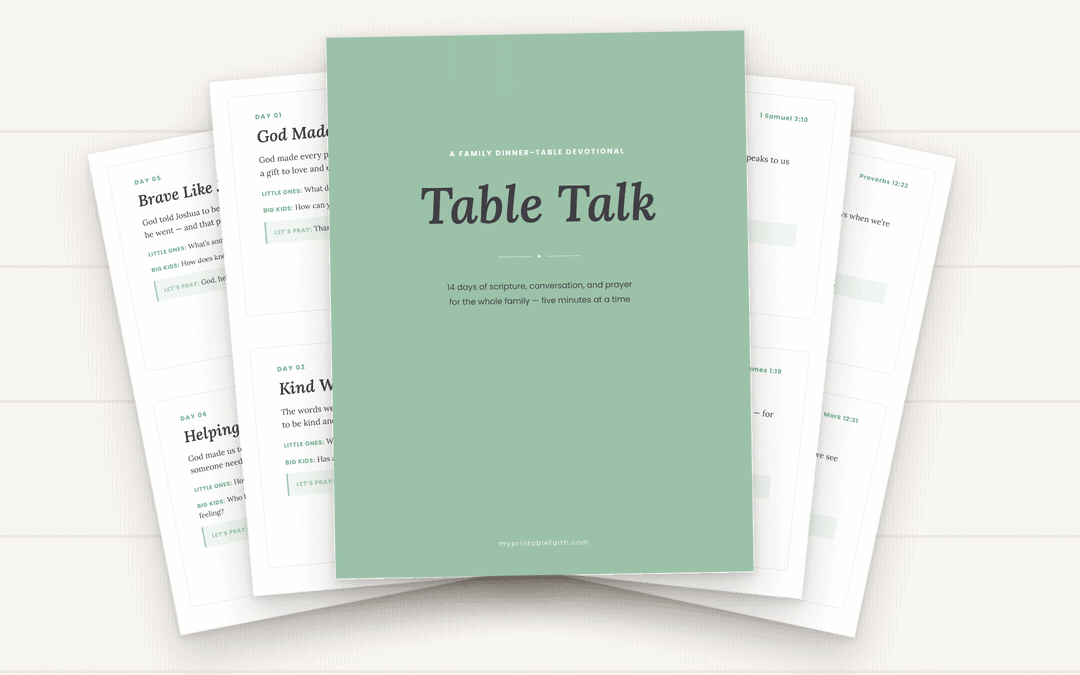
Table Talk is a set of 14 dinner-table devotional cards. Not a book, not a 20-minute lesson plan, not something that requires anyone to have their Bible open before the food’s even served. Just a card. One short scripture-based thought, a couple of questions to get everyone actually talking, and a one-line prayer to close it out. The whole thing takes less time than it takes everyone to finish their plates.
I wrote these specifically for the reality of family dinners, which is to say: someone’s going to be a bit distracted, someone might complain, and you’ve probably got a decent range of ages at the table who are all going to engage with this differently. So each card has one question aimed at your littlest ones and a separate, slightly deeper question for your older kids or teens. Everyone gets pulled into the conversation at a level that actually makes sense for them, instead of the little ones zoning out or the teenagers rolling their eyes because it’s “too babyish.”
What’s Actually on Each Card
Every one of the 14 cards includes:
A short devotional thought (a few sentences, not a sermon) tied to a Bible reference
A question for the little ones at your table
A separate question for the big kids and teens
A simple prayer prompt to pray together before everyone scatters
The themes move through things that actually come up in real family life — kindness, saying sorry, patience, being brave, thinking of others, honesty, and a few days just soaking in how much God loves your family exactly as it is, mess and all. Nothing preachy, nothing that requires a theology degree to explain to a six-year-old. Just short, honest conversations that fit into the life you’re already living.
How I’d Actually Use These
Print the set out, cut the cards apart (it’s just one cut down the middle of each page, so it won’t eat up your whole afternoon), and pop them in something near the table. I use an old recipe box, but a mug, a rubber band, or a random kitchen drawer works just as well. Nobody needs to see a schedule or a checklist.
Then, once dinner’s mostly done but before anyone’s excused, grab a card. Read the little devotional part out loud. Ask the question — maybe go around the table, maybe just throw it out there and see who bites. Pray the short prayer together, or let one of the kids pray it if they’re up for it. Done. You’ve just had a family devotion, and nobody had to sit through a chapter of anything.
You don’t have to do them in order, and you definitely don’t have to do all 14 in a row without missing a night. Some weeks you might do four nights in a row and then not touch them again for two weeks. That’s fine. This isn’t meant to be one more thing you feel behind on — it’s meant to be an easy yes on the nights you do have five minutes to spare.
Why I Think This Actually Matters
I homeschool my daughter, which means I already spend a huge chunk of my day being the one responsible for what she’s learning. Some days that feels like plenty of “teaching,” and honestly, faith conversations can end up being the thing that slips through the cracks simply because school already took up so much of the day’s energy.
But there’s something different about a conversation that happens over dinner, when nobody’s being graded and nobody has to write anything down. It’s not a lesson. It’s just talking, as a family, about things that actually matter — and letting your kids hear you wrestle with a question just as much as they do. My favourite moments with these kinds of prompts aren’t usually when my daughter gives a lovely, tidy answer. It’s when a question sits there a bit awkwardly for a second, and then somebody says something honest.
That’s really the whole goal here. Not perfect theology, not a completed workbook, just five minutes of your family talking about God together, out loud, on a regular Tuesday.
A Couple of Practical Tips
If you’ve got a really little one at the table who can’t read yet, that’s totally fine — the questions are meant to be read aloud to them anyway, not handed over for them to work through alone. And if your “big kid” question feels a bit too advanced for where your teen is at (or too easy, and they roll their eyes at you), don’t be afraid to swap it out for a follow-up question of your own. These cards are a starting point for conversation, not a strict script you have to follow word for word.
I’d also gently say: don’t wait until you feel like you’ll do this “properly.” You don’t need the right binder, the right time of day, or everyone to be in a good mood before you start. Honestly, some of our best faith conversations as a family haven’t come from anything formal at all — they’ve popped up on their own, in the car or over the dishes, when nobody was trying to force it. These cards aren’t meant to replace that. They’re just an easy way to open the door on a night when a good conversation isn’t going to happen on its own.
Grab Your Free Copy
Table Talk is completely free to download, and it’s designed to print easily at home — no fancy paper needed, just regular printer paper or cardstock if you want the cards to hold up a bit better to little hands.
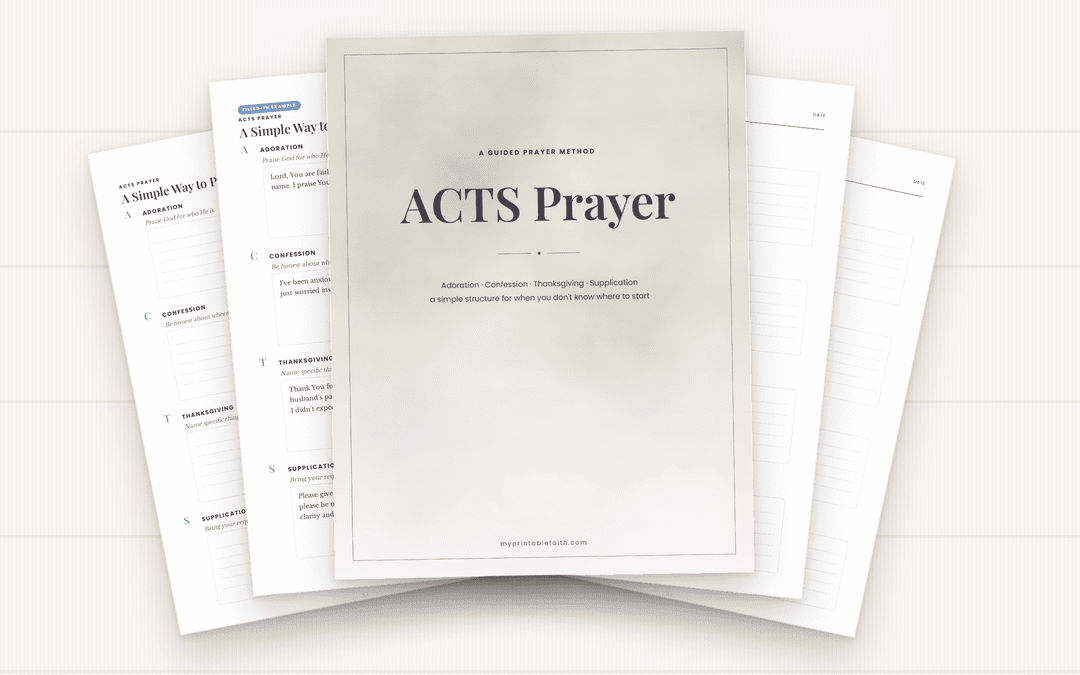
Do you ever sit down to pray and just… blank? Not because you don’t want to pray, but because you’ve said the same three sentences so many times that they’ve stopped feeling like anything. “Thank you for today, please help with this, amen.” It’s not wrong, exactly. It’s just thin.
That’s the gap ACTS prayer fills, and it’s the free printable I’m sharing today.
What Is ACTS Prayer?
ACTS is an acronym that gives your prayer time a simple shape: Adoration, Confession, Thanksgiving, Supplication. Each letter is a different posture to pray from, and the order isn’t random — it’s based on the pattern Jesus gave His disciples when they asked Him how to pray in Luke 11.
You start with Adoration, praising God for who He is, before you get anywhere near what you need from Him. Then Confession, being honest about where you’ve fallen short. Then Thanksgiving, naming specific things you’re grateful for. And only then, Supplication — bringing your actual requests, for yourself and for other people.
It sounds simple because it is. But there’s something about following that order that changes the whole feel of a prayer. You end up somewhere different than “please fix this,” and I think that’s the point.
What’s Inside
This printable includes:
A short explainer on what ACTS prayer is and why the order matters
A completely filled-in example, so you can see exactly what a finished prayer looks like
10 blank templates, ready to use whenever you sit down to pray
Each template has a labeled box for all four steps, with a one-line prompt under each letter so you’re never staring at a blank page wondering what goes where.
How to Use It
Sit down with one template and just work through it top to bottom. You don’t need to write paragraphs — a sentence or two under each heading is plenty. Some days Confession will only get a line. Other days it might be the longest section on the page. That’s fine; this isn’t about filling every box evenly, it’s about actually praying through all four postures instead of skipping straight to what you want.
If you’re not sure how to start Adoration, try finishing the sentence “God, You are…” with something true about His character — faithful, patient, near, in control. For Confession, it helps to be specific rather than general; “I’ve been short with my kids this week” does more than “forgive my sins.” For Thanksgiving, aim for detail — not just “my family,” but the specific moment this week that reminded you why you’re grateful for them. And for Supplication, don’t just pray for yourself; leave room for the people on your mind, too.
There’s no set schedule here. Use a template every morning if that’s your rhythm, once a week if that fits better, or just whenever you notice your prayers have gone a bit flat and you want to reset.
Why I Wanted to Make This
I think a lot of us go through seasons where prayer feels like a habit we’re going through rather than a conversation we’re actually having. Structure sounds like it would make that worse — more of a checklist, less of a relationship — but I’ve found the opposite can be true. Having somewhere to put my praise, my honesty, my gratitude, and my requests, one at a time, actually slows me down enough to mean what I’m saying in each part, instead of rushing through to get to the asking.
It’s also just genuinely useful on the hard days, when you sit down to pray and don’t know what to say at all. Having four simple starting points is enough to get you moving instead of staring at nothing.
A Couple of Practical Notes
The ten templates are meant to be reused as many times as you need — this isn’t a journal you fill in once and finish. Print a handful and keep them somewhere you’ll actually see them: tucked into your Bible, clipped to a prayer binder, or sitting on your nightstand.
If a particular section always feels hardest for you, that’s worth paying attention to. For a lot of people it’s Confession, because honesty is uncomfortable, or Adoration, because praising God for who He is (rather than what He’s done for you lately) doesn’t come as naturally as it sounds. Wherever you get stuck, that’s probably exactly the part worth sitting with a little longer.
Grab Your Free Copy
ACTS Prayer is completely free to download and print at home. It holds up fine on regular printer paper, and cardstock is a nice option if you want your templates to last in a binder long-term.
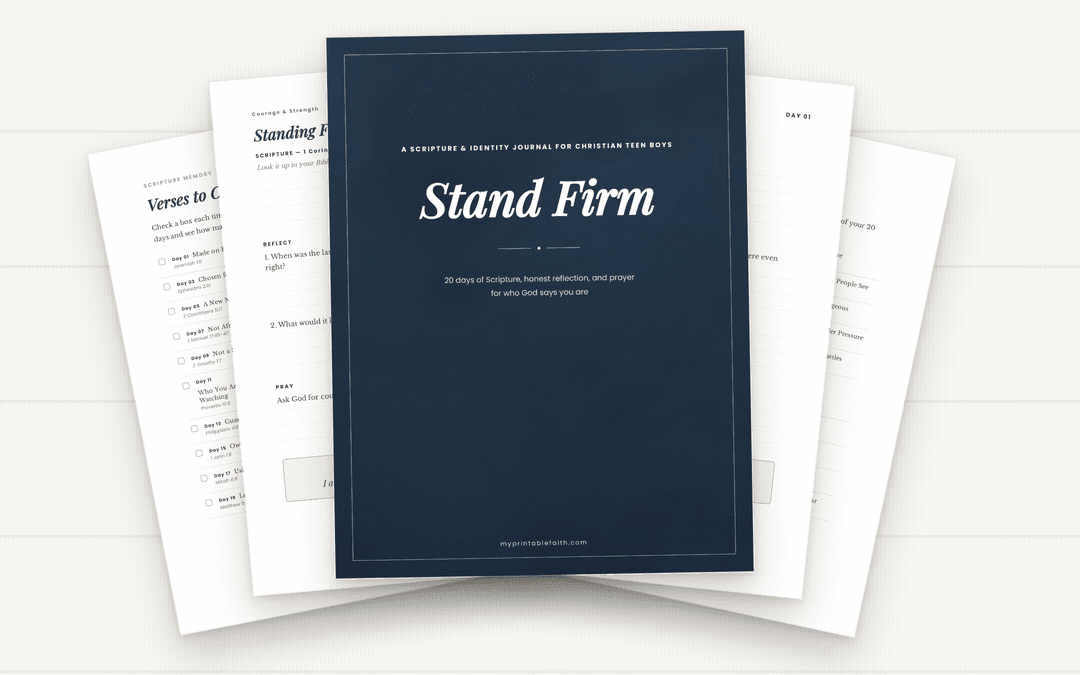
Recently I made Rooted, a scripture and identity journal for teen girls. I always meant to make a version for guys too, and Stand Firm is that companion — twenty days of Scripture, honest reflection, and prayer, written specifically for what actually comes up for teen guys: courage, integrity, pressure, leadership, and figuring out who they are underneath all of that.
What’s Inside
Stand Firm walks through four themes, five days each:
Identity in Christ — who they are before anything they’ve done or accomplished
Courage & Strength — facing real fear and real pressure without folding
Integrity & Character — who they are when nobody’s watching
Purpose & Leadership — using their strength and influence for something bigger than themselves
Each day includes:
A scripture reference (not the verse itself, so it works with whatever Bible translation your family uses) and space to look it up and write it out
Two honest reflection questions — not surface-level, but not so heavy they’ll shut down either
A short prayer prompt
A “Today I’m choosing to stand firm on this” line to finish, giving them one clear truth to walk away with
There’s also a scripture memory tracker at the back listing all twenty verses, so if your son wants to actually memorize a few, he’s got a simple way to track which ones he’s got down.
Why I Made This Different From Rooted
I didn’t want to just swap “girl” for “boy” in the same content — teen guys are generally dealing with a different set of pressures, even when the underlying need (to know who they are in Christ) is exactly the same. So instead of Rooted’s focus on identity, worry, and friendship, Stand Firm leans into courage under pressure, integrity when no one’s watching, and using strength to lead and protect rather than dominate.
I also wanted to stay away from the two extremes a lot of “boy” content falls into — either overly soft with no edge to it at all, or so aggressively “tough guy” that it feels like a costume rather than an honest conversation. Teen guys can handle real talk. They don’t need to be babied, and they don’t need chest-thumping either. They just need someone willing to ask them a real question and actually wait for a real answer.
How to Use It
One day at a time works well, but there’s no required pace here — some weeks might be one page a day, other weeks might be one page total. Both are fine.
If you’re a parent handing this to your son, I’d resist the urge to check his answers or turn it into a discussion he didn’t ask for. Let him have it as his own space. If he wants to talk about something in it, he’ll bring it up. If a particular page clearly connects with something going on in his life right now, that might be a good one to start with instead of going strictly in order.
For dads especially — filling out your own copy alongside your son’s, even just a few pages, can open up conversations that don’t happen naturally otherwise. You don’t have to compare answers. Just going through it in the same season together says something on its own.
A Couple of Practical Notes
The reflection questions are written to be answered honestly, which means some answers might surface things worth a real conversation — pressure at school, something he’s ashamed of, a fear he hasn’t said out loud. That’s not a bug in the design, that’s the whole point. Just be ready for that if it comes up, and don’t push if it doesn’t.
The scripture references are intentionally left as references only, not printed-out verses, so this works with whatever Bible he already has or uses on an app. Looking it up himself is part of the process.
Grab Your Free Copy
Stand Firm is completely free to download and print at home. It’s designed to print cleanly on regular paper — no fancy printer settings needed.
If your son works through this, I’d love to hear which day stuck with him most. Those are always the moments worth knowing about.
Hi, I'm Steph! I want to equip you with faith resources to encourage a love of Gods word in your life.
DISCLAIMER
Some of the links on this website are affiliate links of which My Printable Faith receives a small commission from sales of certain items, but the price is the same for you. As an Amazon Associate I earn from qualifying purchases.
TERMS OF USE
All our printables are for personal or free ministry use only.
If you wish to share our printables on your website, you may do so with a do-follow backlink to the blog page and credit. You may not share the files or images directly on your site.