Visual aids can help us see and focus on what is important to us. They can help us with understanding, with communication, they can act as motivators and emotional stimulators, and they can help us to remember things for longer.
A Vision Board is a visualization tool that can do all of the above.
It is a board where you can display words and pictures that represent your plans, goals and dreams, and bring focus and motivation to those plans, goals and dreams.
A Faith Vision Board adds another dimension to your board by bringing God into those visions, hopes, plans and dreams.
As a Faith and Family Vision Board this will be a place where you can display your goals and dreams for your family, your children, your relationships, your life.
It may include things you want to achieve, like character qualities of love or forgiveness or generosity, or it may be something like a family holiday where you can spend quality time together, or a mission trip you would like to do together, it could be a desire for your children to have healthy friendships, or a desire to open your home more to others.
Whatever it is, it will be unique to your family.
How do I start?
As Christians, making a faith vision board is not the same as creating a manifestation board where we are filling it with what we want and what we want to happen, outside of God’s plans for us.
Instead, I would encourage you to pray first and ask the Lord what He would have you place on your faith vision board.
Proverbs 3:5-6 says, “Trust in Yahweh with all your heart, and don’t lean on your own understanding. In all your ways acknowledge him, and he will make your paths straight”.
And, Proverbs 19:21 which says, “There are many plans in a man’s heart, but Yahweh’s counsel will prevail”.
God’s plans for us are good, and He wants to give us hope and a good future (Jeremiah 29:11).
What materials will I need?
You will need a board of course. It could be a poster board, a piece of cardboard, or a large photo frame, something that is big enough to hold the things you want to pin to it and that you can place somewhere in your home where everyone can see it and be a part of it.
You may want some magazines, photos and other artwork where you can cut pictures and words to use. You can also make and print your own words and pictures, or you can use stickers.
Depending on what your board is made of you will also need pins, or glue, or Blu Tack to hang your words and pictures and scissors to cut things out.
What should go on my board?
You may want to start with a Bible verse, something that is central to your family and represents where your heart is. You can write this out or print it on your computer.
Go through your magazines and other materials and start looking for words and pictures that inspire you, cut them out and put them aside.
Once you have your pictures and words you can start arranging them on your board. When you are happy with the design and layout you can then glue or pin things on.
And there you have it! Your family’s very own, unique, Family Vision Board.
Once it’s dry you can display it where everyone can see it and it can be a reminder of the things that are important to you as a family. It can also act as a prayer prompt during family devotions.
Are you looking for a way to get more out of your Bible reading time?
Would you like to stay more focussed on what you are reading?
Would you like to make your Bible reading more interesting?
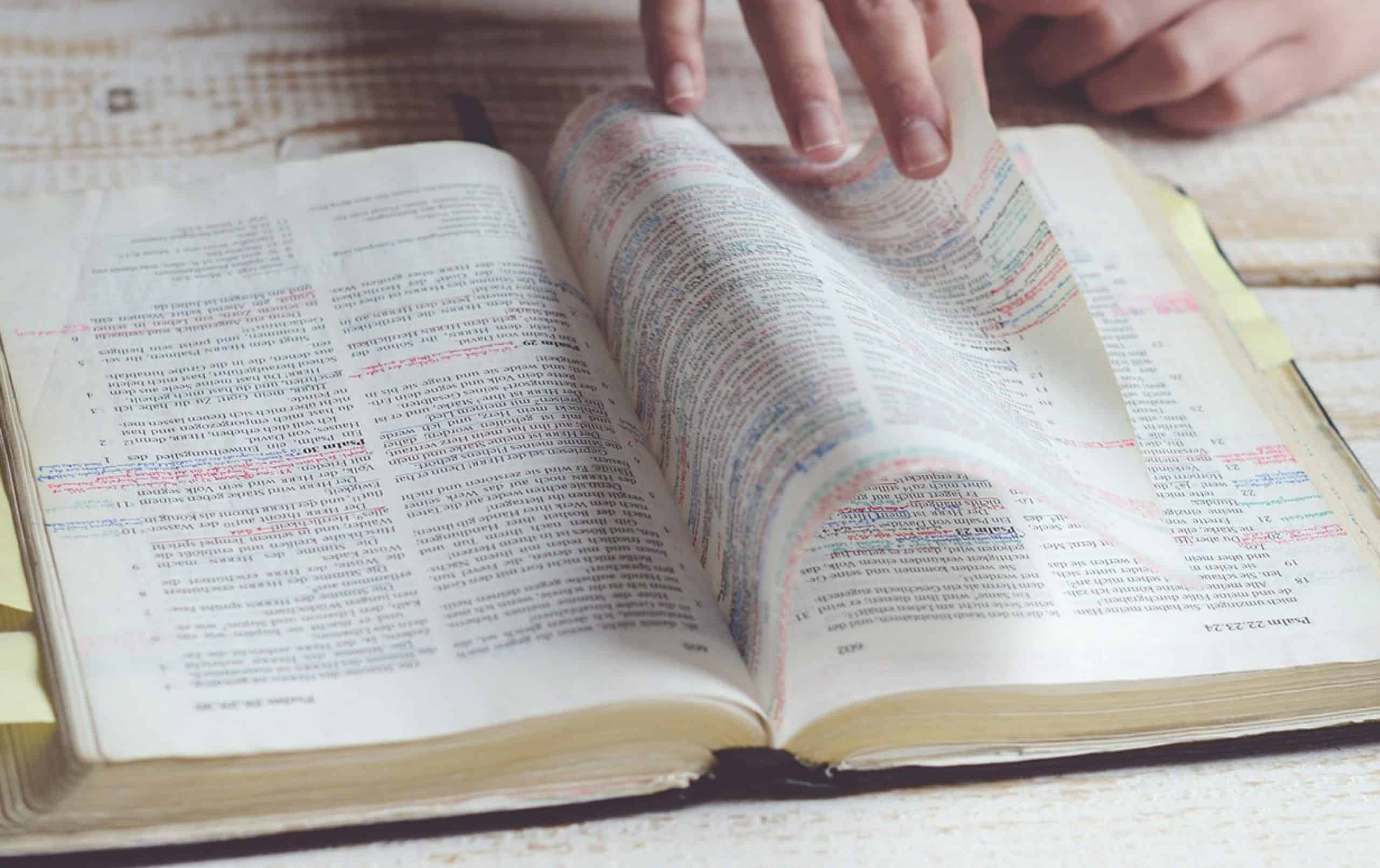
Color coding your Bible may be the answer.
What is color coding?
Color coding your Bible is using colors to highlight or mark out important or meaningful words, phrases or even passages using different colors.
You may use one color to highlight one category such as God’s character, another color for faith, another color for prayer, another for God’s promises and so on.
What are the benefits?
The main benefit of color coding is that it slows down the reading process, it gives you an opportunity to think about what you are reading, and allows you time to process the passage or verse.
It can help you to stay more focussed on what you are reading and a little less open to distractions.
It adds structure to what you are doing rather than just randomly highlighting verses with no real format to it.
Color coding can make it easier to find special passages at a later time. For example, if you are having a difficult day and you want to be encouraged by God’s promises you can easily go to your Bible and find the promises you have highlighted.
What do I need?
Firstly, you need a plan. Think about what categories you want to work with and which colors you want to allocate them. For example you may use God (Blue), Jesus (Red), Holy Spirit (Purple), Prayer (Aqua), Promises (Yellow), Sin (Brown), Faith (Orange), whatever you want and however many you want.
Then you will need your colors. You can use pencils, pens, highlighters, but be careful, especially if your Bible has thin pages, that your colors don’t bleed through to the other side of your page. You may also want to use a ruler to keep lines straight, or an eraser in case of any mistakes, and of course a pencil sharpener to keep your pencils in good coloring condition.
How do I do it?
Now to get started!
I think it’s always a good idea to pray first before any study of the Scriptures.
Psalm 119:18 says, “Open my eyes, that I may see wondrous things out of your law”. I like to ask the Holy Spirit to open my spiritual eyes to see and understand what He wants to show me and teach me.
Next read the passage through at least once without making any markings. Read the passage through again this time asking yourself questions about the passage, the context, the author, the recipients, use the cross references (usually found either at the bottom of the page or in the centre column) to gain a better understanding of the passage and how it fits in the context of the Bible as a whole.
As you read through the third time you are ready to start color coding. You can read through as many times as you need to go through each of your categories and marking up what you find.
You may also want to use a notebook or a journal to record what the Holy Spirit has shown you.
James 1:22-25 encourages us to be doers of the Word and not just hearers only. Once you have finished your Bible reading and color coding you may want to pray again and ask God to help you to apply the things that you have learned into your life.
As you spend the time color coding, and thinking more deeply about God’s Word, you will find yourself reflecting on God’s Word more throughout the day.
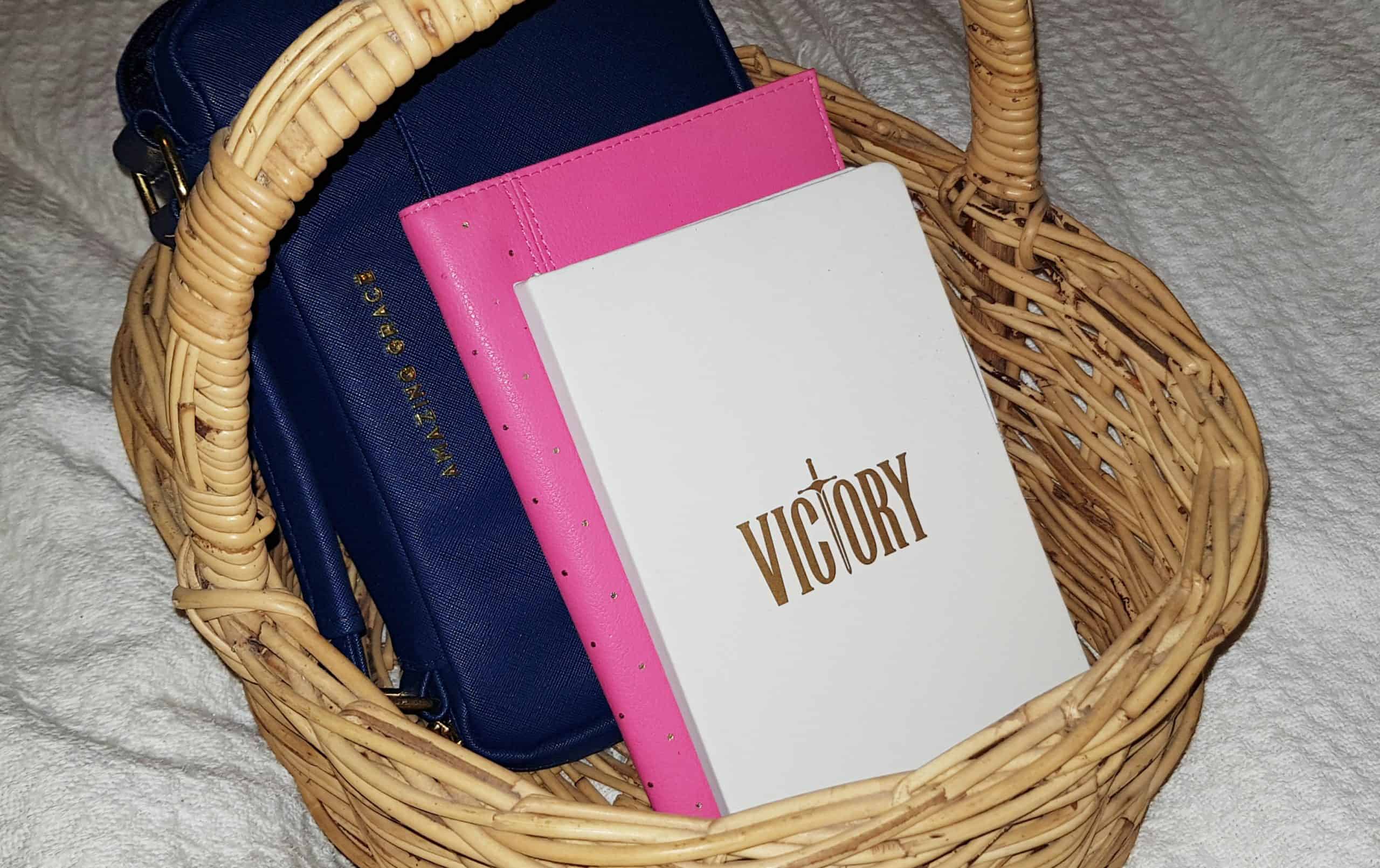
A Bible Study Basket is just what it sounds like, a basket you use for your Bible Study. It’s a place where you can keep all of your Bible study tools, everything you need for your Bible study, your Bible Colour Coding, and your Scripture Journaling.
Why should I have one?
I have to admit, I only heard about a Bible Study Basket just recently, and at first I thought, why? But as I thought about it, I thought what a great idea!
For a start, it is a great visual reminder to make Bible Study a priority. I know I want to make Bible study a priority but sometimes life can get so busy that the day gets away and it can be easily forgotten. Having a basket there is just a visual reminder not to forget to spend that all important time reading God’s Word.
Another thing I like about it is that everything is in one place. I don’t have to go looking for, or gather together, my Bible, my pencils, my journals etc as they are already there in the one place.
It also means that I can pick it up anytime and I’m good to go. I can easily take it to any room in the house I want, or in the yard, or the park, or wherever I want to spend my time with God on any particular day.
And, if it’s put together well, it can look good too!
What should I have in my basket?
Bible
You may have a favorite Bible you like to use, or you may decide to buy a new Bible to start your basket. There are many different versions and types of Bibles to choose from, and it’s a very personal choice. It can be helpful to have a study Bible, as it will have additional resources such as book summaries, cross referencing, maps, or additional information that can be helpful as you study the Word.
Bible Reading Plan
Sometimes it can be hard to know where to start so you may want to use a Bible Reading Plan. This resource can help you know what to read and where to start. They can be especially helpful if you have a goal such as reading through the Bible in a year. You can also use other Bible Reading resources that lead you through verses, passages and topics. Or, you can work your way through a particular book of the Bible or the Psalms.
Resource Books
There are many resources out there. You may want to have a Bible dictionary or concordance, to help with those tricky words that inevitably show up, or to reference names and places.
Bible Journal
A Bible Journal is a great place to write down your thoughts as you go through God’s Word. Putting words on paper can help to clarify your thoughts and help you to remember points you may want to hold on to. You may also make a note about something you would like to come back to at a later time, or something you would like to study more deeply. It can also be a great record of what God is doing in your life, and an encouragement as you read back over the things God has shown you.
Prayer Journal
You may have a prayer journal in your basket. Prayer journals are a great way to organize your prayer life and stay focussed on the people and things you would like to pray for. You can also make notes of answered prayers, which is always a great encouragement to look back on. A prayer journal can also be used to write out your prayers, you may write them out in points, or you may like to write out your prayers in full.
Bible Memory Cards
You may want to have Bible Memory Cards in your basket, or, make some yourself using verses from you Bible study. Colossians 3:16 encourages us to “let the Word of Christ dwell in us richly”. Committing God’s Word to memory is a great way to renew our minds (Romans 12:2) and hide His Word in our hearts (Psalm 119:11). The Sword of the Spirit, which is the Word of God (Ephesians 6:10-20) is part of our spiritual armour, and is our weapon against the enemy, and when facing temptation. Jesus memorized scripture, and He used it against the devil in the wilderness (Matthew 4).
Pencils, Pens, Highlighters and Pencil Case
As you read and study your Bible you may want to colour code your Bible, or practice Bible journaling, or just underline words or verses that have particular meaning to you. If you don’t like to write in your Bible then you can use pencils, pens and highlighters to write in your Bible Journal or your Prayer Journal.
Stickers and Sticky Notes
Using stickers can be a fun way of highlighting, or drawing attention to, something special that you have read, or for using in your journals. They can have a specific purpose, or can be purely decorative. Use your imagination and have fun with it.
Candle
You may like to light a candle for your Bible study time to create a special mood, or a special ‘space’, or a sense of reverence. Having a candle burning during this time can also be a visual signal to your family that you are spending time with God and, hopefully, encourage them to not interrupt or distract you during that time.
A special mug
I like to have a cup of tea when I’m reading, so, whether your preference is tea or coffee, it can be nice to have a special mug to use during your study time. It may be a favourite mug, it may have an inspirational quote on it or it may have a Bible verse on it, whatever it looks like it can live in your basket, ready for you when you need it.
A special basket
Of course, a Bible Study Basket would not be complete without a basket! It can be as plain, or as pretty as you like. Once you know what you want to keep in it you will be able to choose the right size.
Once you have all these things together you are ready to go.
Have fun with your basket and have enjoy soaking up God’s Word as you spend time studying.
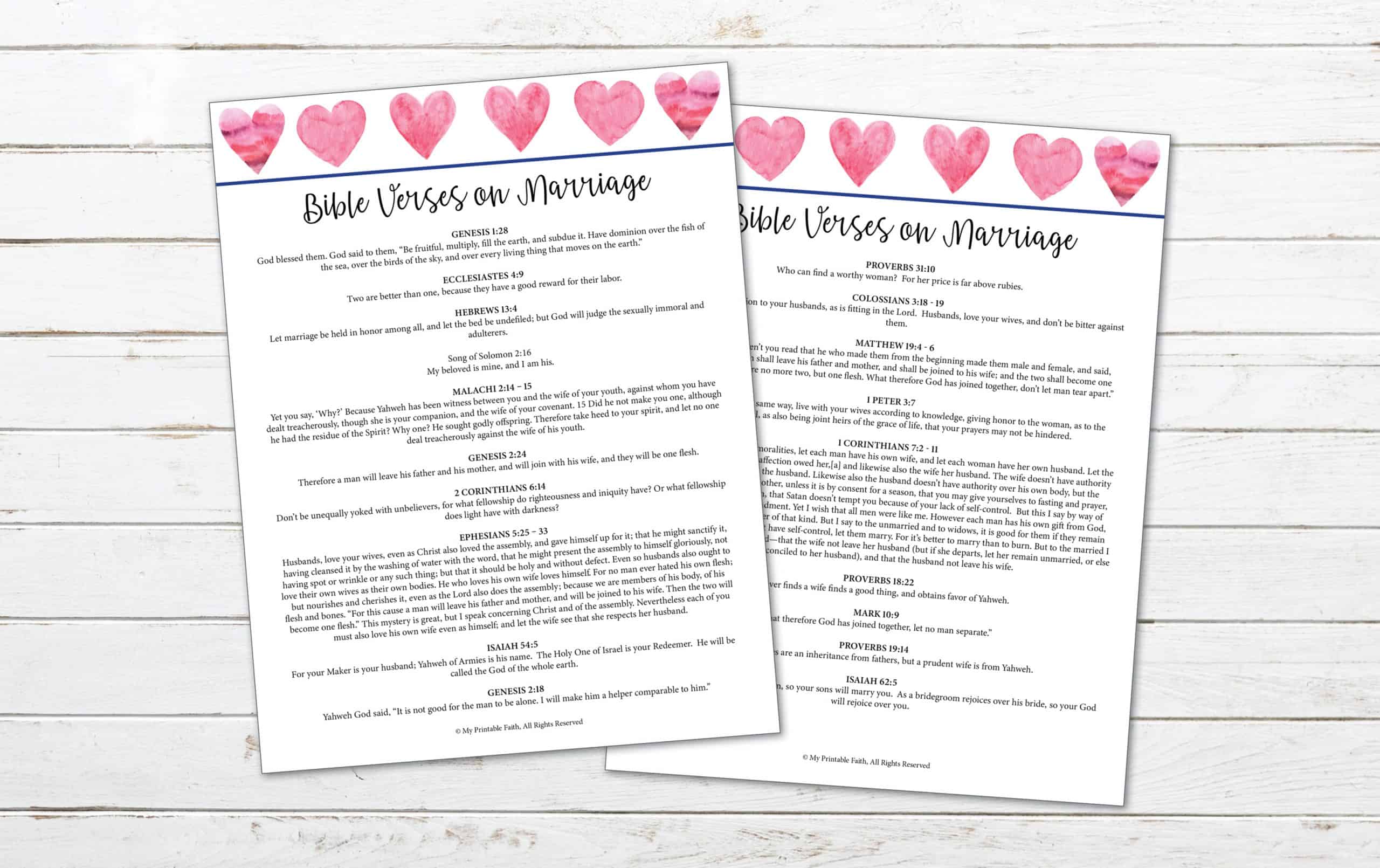
Whether you are looking for verses for your wedding day, or just want to know what the Bible has to say about marriage, here are some Scripture verses that talk about marriage.
Genesis 1:28 God blessed them. God said to them, “Be fruitful, multiply, fill the earth, and subdue it. Have dominion over the fish of the sea, over the birds of the sky, and over every living thing that moves on the earth.”
Ecclesiastes 4:9 Two are better than one, because they have a good reward for their labor.
Hebrews 13:4 Let marriage be held in honor among all, and let the bed be undefiled; but God will judge the sexually immoral and adulterers.
Song of Solomon 2:16 My beloved is mine, and I am his.
Malachi 2:14 – 15 Yet you say, ‘Why?’ Because Yahweh has been witness between you and the wife of your youth, against whom you have dealt treacherously, though she is your companion, and the wife of your covenant. 15 Did he not make you one, although he had the residue of the Spirit? Why one? He sought godly offspring. Therefore take heed to your spirit, and let no one deal treacherously against the wife of his youth.
Genesis 2:24 Therefore a man will leave his father and his mother, and will join with his wife, and they will be one flesh.
2 Corinthians 6:14 Don’t be unequally yoked with unbelievers, for what fellowship do righteousness and iniquity have? Or what fellowship does light have with darkness?
Ephesians 5:25 – 33 Husbands, love your wives, even as Christ also loved the assembly, and gave himself up for it; that he might sanctify it, having cleansed it by the washing of water with the word,that he might present the assembly to himself gloriously, not having spot or wrinkle or any such thing; but that it should be holy and without defect. Even so husbands also ought to love their own wives as their own bodies. He who loves his own wife loves himself. For no man ever hated his own flesh; but nourishes and cherishes it, even as the Lord also does the assembly; because we are members of his body, of his flesh and bones. “For this cause a man will leave his father and mother, and will be joined to his wife. Then the two will become one flesh.” This mystery is great, but I speak concerning Christ and of the assembly.Nevertheless each of you must also love his own wife even as himself; and let the wife see that she respects her husband.
Isaiah 54:5 For your Maker is your husband; Yahweh of Armies is his name. The Holy One of Israel is your Redeemer. He will be called the God of the whole earth.
Genesis 2:18 Yahweh God said, “It is not good for the man to be alone. I will make him a helper comparable to him.”
Proverbs 31:10 Who can find a worthy woman? For her price is far above rubies.
Colossians 3:18 – 19 Wives, be in subjection to your husbands, as is fitting in the Lord. Husbands, love your wives, and don’t be bitter against them.
Matthew 19:4 – 6 He answered, “Haven’t you read that he who made them from the beginning made them male and female, and said, ‘For this cause a man shall leave his father and mother, and shall be joined to his wife; and the two shall become one flesh?’ So that they are no more two, but one flesh. What therefore God has joined together, don’t let man tear apart.”
1 Peter 3:7 You husbands, in the same way, live with your wives according to knowledge, giving honor to the woman, as to the weaker vessel, as also being joint heirs of the grace of life, that your prayers may not be hindered.
1 Corinthians 7:2 – 11 But, because of sexual immoralities, let each man have his own wife, and let each woman have her own husband. Let the husband give his wife the affection owed her,[a] and likewise also the wife her husband. The wife doesn’t have authority over her own body, but the husband. Likewise also the husband doesn’t have authority over his own body, but the wife. Don’t deprive one another, unless it is by consent for a season, that you may give yourselves to fasting and prayer, and may be together again, that Satan doesn’t tempt you because of your lack of self-control. But this I say by way of concession, not of commandment.Yet I wish that all men were like me. However each man has his own gift from God, one of this kind, and another of that kind. But I say to the unmarried and to widows, it is good for them if they remain even as I am. But if they don’t have self-control, let them marry. For it’s better to marry than to burn. But to the married I command—not I, but the Lord—that the wife not leave her husband(but if she departs, let her remain unmarried, or else be reconciled to her husband), and that the husband not leave his wife.
Proverbs 18:22 Whoever finds a wife finds a good thing, and obtains favor of Yahweh.
Mark 10:9 What therefore God has joined together, let no man separate.”
Proverbs 19:14 House and riches are an inheritance from fathers, but a prudent wife is from Yahweh.
Isaiah 62:5 For as a young man marries a virgin, so your sons will marry you. As a bridegroom rejoices over his bride, so your God will rejoice over you.
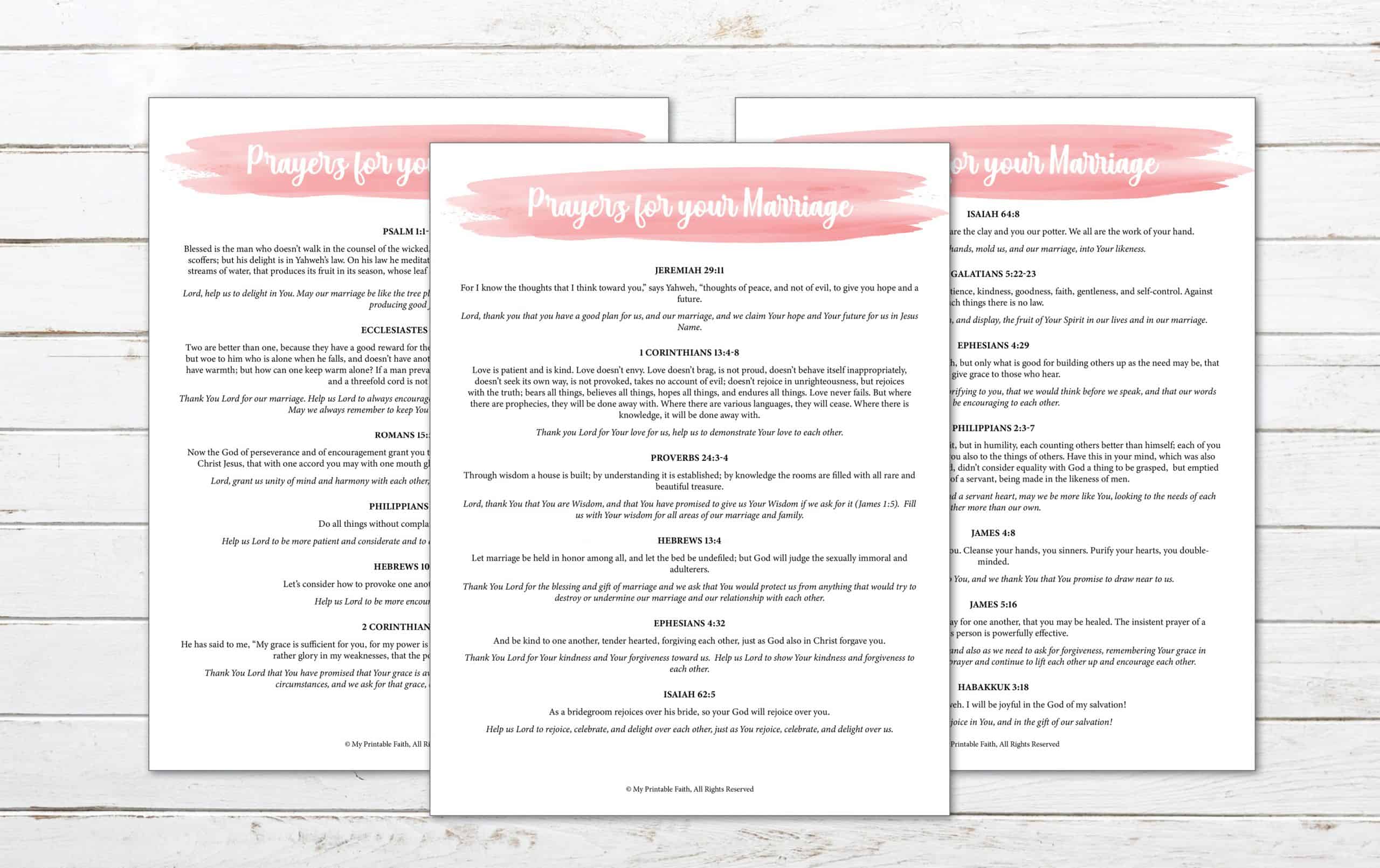
Even the best of marriages can be challenging, and nothing at all like what is portrayed in the movies. God cares about you, and your marriage, and wants to help you. Praying through Scripture is a powerful thing. If you would like to pray Scriptures to strengthen and empower your marriage, click here.
Marriage is not easy. Falling in love is easy, but marriage can be hard work. Marriage relationships require unconditional love and forgiveness from both parties, and a commitment to making a life together.
Ecclesiastes 4:9-12 says that two are better than one as they can help and support each other and verse 12 says that a threefold cord is not quickly broken.
When we invite Jesus into our marriage, that threefold cord is created. It is no longer just the two of you working at it, but you have the resources of heaven to call on as well.
God’s Word is powerful, and it says that the prayers of the righteous person are powerful and effective (James 5:16).
As we pray scripture God promises that it will accomplish His purposes and prosper (Isaiah 55:11).
Here are 19 scriptures you can pray for your marriage.
Jeremiah 29:11
For I know the thoughts that I think toward you,” says Yahweh, “thoughts of peace, and not of evil, to give you hope and a future.
Lord, thank you that you have a good plan for us, and our marriage, and we claim Your hope and Your future for us in Jesus Name.
1 Corinthians 13:4-8
Love is patient and is kind. Love doesn’t envy. Love doesn’t brag, is not proud, doesn’t behave itself inappropriately, doesn’t seek its own way, is not provoked, takes no account of evil; doesn’t rejoice in unrighteousness, but rejoices with the truth; bears all things, believes all things, hopes all things, and endures all things. Love never fails. But where there are prophecies, they will be done away with. Where there are various languages, they will cease. Where there is knowledge, it will be done away with.
Thank you Lord for Your love for us, help us to demonstrate Your love to each other.
Proverbs 24:3-4
Through wisdom a house is built; by understanding it is established; by knowledge the rooms are filled with all rare and beautiful treasure.
Lord, thank You that You are Wisdom, and that You have promised to give us Your Wisdom if we ask for it (James 1:5). Fill us with Your wisdom for all areas of our marriage and family.
Hebrews 13:4
Let marriage be held in honor among all, and let the bed be undefiled; but God will judge the sexually immoral and adulterers.
Thank You Lord for the blessing and gift of marriage and we ask that You would protect us from anything that would try to destroy or undermine our marriage and our relationship with each other.
Ephesians 4:32
And be kind to one another, tender hearted, forgiving each other, just as God also in Christ forgave you.
Thank You Lord for Your kindness and Your forgiveness toward us. Help us Lord to show Your kindness and forgiveness to each other.
Psalm 1:1-3
Blessed is the man who doesn’t walk in the counsel of the wicked, nor stand on the path of sinners, nor sit in the seat of scoffers; but his delight is in Yahweh’s law. On his law he meditates day and night. He will be like a tree planted by the streams of water, that produces its fruit in its season, whose leaf also does not wither. Whatever he does shall prosper.
Lord, help us to delight in You. May our marriage be like the tree planted by the streams of water, growing, prospering, and producing good fruit.
Ecclesiastes 4:9-12
Two are better than one, because they have a good reward for their labor. For if they fall, the one will lift up his fellow; but woe to him who is alone when he falls, and doesn’t have another to lift him up. Again, if two lie together, then they have warmth; but how can one keep warm alone? If a man prevails against one who is alone, two shall withstand him; and a threefold cord is not quickly broken.
Thank You Lord for our marriage. Help us Lord to always encourage each other, support each other, and build each other up. May we always remember to keep You central to our relationship.
Isaiah 62:5
As a bridegroom rejoices over his bride, so your God will rejoice over you.
Help us Lord to rejoice, celebrate, and delight over each other, just as You rejoice, celebrate, and delight over us.
Romans 15:5-6
Now the God of perseverance and of encouragement grant you to be of the same mind with one another according to Christ Jesus, that with one accord you may with one mouth glorify the God and Father of our Lord Jesus Christ.
Lord, grant us unity of mind and harmony with each other, and with You, that we may glorify You together.
Philippians 2:14
Do all things without complaining and arguing.
Help us Lord to be more patient and considerate and to do all things without complaining or arguing.
Hebrews 10:24
Let’s consider how to provoke one another to love and good works
Help us Lord to be more encouraging of each other.
2 Corinthians 12:9
He has said to me, “My grace is sufficient for you, for my power is made perfect in weakness.” Most gladly therefore I will rather glory in my weaknesses, that the power of Christ may rest on me.
Thank You Lord that You have promised that Your grace is available, and sufficient for us, not matter what our circumstances, and we ask for that grace, especially in our times of need.
Isaiah 64:8
But now, Yahweh, you are our Father. We are the clay and you our potter. We all are the work of your hand.
Lord, we are the clay in Your hands, mold us, and our marriage, into Your likeness.
Galatians 5:22-23
But the fruit of the Spirit is love, joy, peace, patience, kindness, goodness, faith,gentleness, and self-control. Against such things there is no law.
Lord, we ask that You would help us to grow in, and display, the fruit of Your Spirit in our lives and in our marriage.
Ephesians 4:29
Let no corrupt speech proceed out of your mouth, but only what is good for building others up as the need may be, that it may give grace to those who hear.
Lord, we ask that our speech would always be glorifying to you, that we would think before we speak, and that our words would be encouraging to each other.
Philippians 2:3-7
Doing nothing through rivalry or through conceit, but in humility, each counting others better than himself; each of you not just looking to his own things, but each of you also to the things of others. Have this in your mind, which was also in Christ Jesus, who, existing in the form of God, didn’t consider equality with God a thing to be grasped, but emptied himself, taking the form of a servant, being made in the likeness of men.
Thank You Lord for Your example of humility and a servant heart, may we be more like You, looking to the needs of each other more than our own.
James 4:8
Draw near to God, and he will draw near to you. Cleanse your hands, you sinners. Purify your hearts, you double-minded.
We come to You Lord, to draw near to You, and we thank You that You promise to draw near to us.
James 5:16
Confess your offenses to one another, and pray for one another, that you may be healed. The insistent prayer of a righteous person is powerfully effective.
Help us Lord in our forgiveness of each other, and also as we need to ask for forgiveness, remembering Your grace in forgiving us. Help us to hold each other in prayer and continue to lift each other up and encourage each other.
Habakkuk 3:18
Yet I will rejoice in Yahweh. I will be joyful in the God of my salvation!
Together Lord, we rejoice in You, and in the gift of our salvation!
The enemy wants to destroy marriages and families. We are not just in an earthly struggle, but a spiritual one (Ephesians 6:12). God wants to be a part of our lives, and our marriage, to protect, encourage, strengthen and sustain us. May the truth of God’s Word be at work in your lives, and in your marriage (1 Thessalonians 2:13).
Our first introduction to God as ‘I AM’ is when He spoke with Moses in Exodus 3:13-14.
Moses said to God, “Behold, when I come to the children of Israel, and tell them, ‘The God of your fathers has sent me to you,’ and they ask me, ‘What is his name?’ what should I tell them?”
God said to Moses, “I AM WHO I AM,” and he said, “You shall tell the children of Israel this: ‘I AM has sent me to you.’”
‘I AM’ is a clear declaration, a statement of who God is.
In John 8:58, Jesus made a statement about Himself to the Jewish people, it was a very profound statement as He not only claims His existence before Abraham some 2000 years previous, but also as He equates Himself with God in His reference to Exodus 3:14.
“Most certainly, I tell you, before Abraham came into existence, I AM”. John 8:58
Throughout the Gospel of John there are seven other times that Jesus uses the ‘I AM’ statement about Himself. The declarations not only tell us who Jesus is, His character and purpose, but it also affirms His status as God Himself and His work in the lives of His people.
Let’s take a closer look at each of the seven ‘I AM’ declarations of Jesus.
I AM… The Bread of Life
Jesus said to them, “I am the bread of life. Whoever comes to me will not be hungry, and whoever believes in me will never be thirsty. John 6:35
Just as physical bread sustains us physically, Jesus, the Bread of Life promises to sustain us spiritually.
Jesus showed He could provide for the crowd’s physical needs when they were hungry, by producing an abundance of food, with leftovers, feeding thousands, all from five loaves and two fish. John 6:1-15
If Jesus can provide for our physical nourishment, how much more, as the Son of God, can He provide for our spiritual nourishment.
Spiritual nourishment and strength comes from knowing Jesus, His love and forgiveness, and growing in our relationship with Him. Only Jesus can truly satisfy. Psalm 107:9 says, “For he satisfies the longing soul. He fills the hungry soul with good”.
I AM… The Light of the World
Again, therefore, Jesus spoke to them, saying, “I am the light of the world. He who follows me will not walk in the darkness, but will have the light of life.” John 8:12
Light is essential to life and growth. Without light plants will not grow, there would be no warmth, no food, no gravitational pull, no life. Without light we would be in the dark and we would not be able to see.
Jesus, as the Light of the World, offers to take us out of the darkness of our old life, and bring us into His light, His glorious presence (1 Peter 2:9). Light can illuminate the good and the bad, where we fall short of God’s perfection, as well as showing us His revelation through His Word (John 1:9).
This light can bring illumination to our day to day life too, as we allow God to guide and lead us, as He shines His Light on our path (Psalm 119:105).
In Matthew 5:14-15 He also asks us to be lights in the world, helping others to find the way out of their darkness and into relationship with Him.
I AM… The Door – of the sheep
Jesus therefore said to them again, “Most certainly, I tell you, I am the sheep’s door. All who came before me are thieves and robbers, but the sheep didn’t listen to them. I am the door. If anyone enters in by me, he will be saved, and will go in and go out, and will find pasture. John 10:7.9
We all know what a door is, and we know it’s purpose. It’s an entrance, it’s the way in. Jesus declares that He is the Door to salvation, He is the way to a relationship with God. If we want to enter a room, or a house, we go through door. If we want to enter into a relationship with God, we go through Jesus.
I AM… The Resurrection and the Life
Jesus said to her, “I am the resurrection and the life. He who believes in me will still live, even if he dies. John 11:25
Jesus says that He is the Resurrection and the Life, it is a declaration that He has won the victory over death. We see Him demonstrate this in John 11 where, after Lazarus had been dead for 4 days, He called him out from the tomb and raised him from the dead.
Jesus proved again that He had power over death when He rose from the dead (Matthew 28, Mark 16, Luke 24, John 20). Jesus is alive! He is a living Savior and we can have a living relationship with Him.
For those of us who have put their faith and trust in Jesus, we do not need to fear death, it is a doorway to the heavenly realm where we can spend eternity with God in His presence.
I AM… The Good Shepherd
I am the good shepherd. The good shepherd lays down his life for the sheep. He who is a hired hand, and not a shepherd, who doesn’t own the sheep, sees the wolf coming, leaves the sheep, and flees. The wolf snatches the sheep, and scatters them. The hired hand flees because he is a hired hand, and doesn’t care for the sheep. I am the good shepherd. I know my own, and I’m known by my own; even as the Father knows me, and I know the Father. I lay down my life for the sheep. John 10:11-15
What does a shepherd do?
A shepherd’s primary responsibility is to protect the safety and wellbeing of the sheep. Sheep are vulnerable and defenceless, without a Shepherd to protect them they are prey for wolves, thieves, and other dangers.
As our Good Shepherd, Jesus gave His life to protect us and to save us. He wants us to accept His gift of salvation, and He wants to guard and protect us as we do life on our journey with Him.
Psalm 23 speaks beautifully of Jesus our Shepherd, as our provider, comforter, restorer, and guide.
I AM… The Way, the Truth, the Life
Jesus said to him, “I am the way, the truth, and the life. No one comes to the Father, except through me. John 14:6
Jesus is the Way. He is the Way to God, the Way to salvation, the Way when we are lost, the Way when we are afraid. When you are not sure which way to turn, turn to Jesus.
Jesus is the Truth. In a world where truth is no longer an absolute Jesus declares that He is the Truth. He reveals truth, truth about the world, about us, about Himself. In John 8:32 Jesus says, “You will know the truth, and the truth will make you free”. Knowing Jesus, knowing Truth brings freedom.
Jesus is the Life. Faith and salvation in Jesus promises eternal life, life everlasting. In John 10:10 Jesus promises life, not just any life, but an abundant life, a rich, lavish, plentiful life. I’m not speaking here of monetary wealth, I am referring to a spiritual wealth, a life of fullness, meaning, purpose and growth, a truly rewarding life here on earth, and with the promise of eternal life with Him.
I AM… The True Vine
“I am the true vine, and my Father is the farmer. Every branch in me that doesn’t bear fruit, he takes away. Every branch that bears fruit, he prunes, that it may bear more fruit. You are already pruned clean because of the word which I have spoken to you. Remain in me, and I in you. As the branch can’t bear fruit by itself unless it remains in the vine, so neither can you, unless you remain in me. I am the vine. You are the branches. He who remains in me and I in him bears much fruit, for apart from me you can do nothing. John 15:1-5
Anyone who has done any gardening, even basic gardening, knows that if you cut of a branch from the main part of the plant, it will die. Jesus is the vine, and we are the branches, we need to remain connected to Him in order to grow and flourish spiritually, allowing His life to flow through us enabling us to grow and bear good fruit (Galatians 5:22-23). He is the source of life, now and forever.
Through the I AM statements Jesus promises to be our spiritual nourishment and strength, our illumination and guide, our way to have a relationship with God, our life and victory, our safety and protection, our salvation, freedom and purpose, and our way to spiritual growth.
He is I AM, from the past, in the present and into the future.
Hi, I'm Steph! I want to equip you with faith resources to encourage a love of Gods word in your life.
DISCLAIMER
Some of the links on this website are affiliate links of which My Printable Faith receives a small commission from sales of certain items, but the price is the same for you. As an Amazon Associate I earn from qualifying purchases.
TERMS OF USE
All our printables are for personal or free ministry use only.
If you wish to share our printables on your website, you may do so with a do-follow backlink to the blog page and credit. You may not share the files or images directly on your site.