
Can we be honest for a second? Family devotion time sounds lovely in theory. In practice, by the time dinner’s on the table, everyone’s tired, someone’s still finishing homework in their head, and the idea of pulling out a whole devotional book and reading a full page feels like one more thing nobody has the energy for. So it just… doesn’t happen. Not because you don’t want it to, but because the moment never quite feels like the right one.
If that sounds even a little bit like your house, I made something for us.
What is Table Talk?
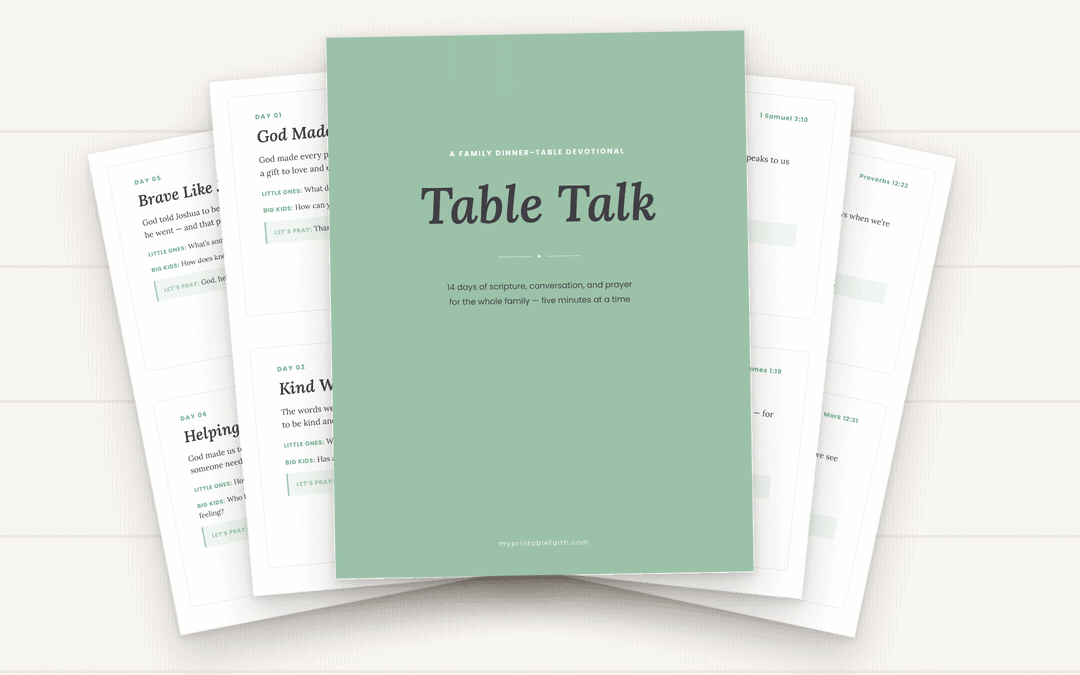
Table Talk is a set of 14 dinner-table devotional cards. Not a book, not a 20-minute lesson plan, not something that requires anyone to have their Bible open before the food’s even served. Just a card. One short scripture-based thought, a couple of questions to get everyone actually talking, and a one-line prayer to close it out. The whole thing takes less time than it takes everyone to finish their plates.
I wrote these specifically for the reality of family dinners, which is to say: someone’s going to be a bit distracted, someone might complain, and you’ve probably got a decent range of ages at the table who are all going to engage with this differently. So each card has one question aimed at your littlest ones and a separate, slightly deeper question for your older kids or teens. Everyone gets pulled into the conversation at a level that actually makes sense for them, instead of the little ones zoning out or the teenagers rolling their eyes because it’s “too babyish.”
What’s Actually on Each Card
Every one of the 14 cards includes:
- A short devotional thought (a few sentences, not a sermon) tied to a Bible reference
- A question for the little ones at your table
- A separate question for the big kids and teens
- A simple prayer prompt to pray together before everyone scatters
The themes move through things that actually come up in real family life — kindness, saying sorry, patience, being brave, thinking of others, honesty, and a few days just soaking in how much God loves your family exactly as it is, mess and all. Nothing preachy, nothing that requires a theology degree to explain to a six-year-old. Just short, honest conversations that fit into the life you’re already living.
How I’d Actually Use These
Print the set out, cut the cards apart (it’s just one cut down the middle of each page, so it won’t eat up your whole afternoon), and pop them in something near the table. I use an old recipe box, but a mug, a rubber band, or a random kitchen drawer works just as well. Nobody needs to see a schedule or a checklist.
Then, once dinner’s mostly done but before anyone’s excused, grab a card. Read the little devotional part out loud. Ask the question — maybe go around the table, maybe just throw it out there and see who bites. Pray the short prayer together, or let one of the kids pray it if they’re up for it. Done. You’ve just had a family devotion, and nobody had to sit through a chapter of anything.
You don’t have to do them in order, and you definitely don’t have to do all 14 in a row without missing a night. Some weeks you might do four nights in a row and then not touch them again for two weeks. That’s fine. This isn’t meant to be one more thing you feel behind on — it’s meant to be an easy yes on the nights you do have five minutes to spare.
Why I Think This Actually Matters
I homeschool my daughter, which means I already spend a huge chunk of my day being the one responsible for what she’s learning. Some days that feels like plenty of “teaching,” and honestly, faith conversations can end up being the thing that slips through the cracks simply because school already took up so much of the day’s energy.
But there’s something different about a conversation that happens over dinner, when nobody’s being graded and nobody has to write anything down. It’s not a lesson. It’s just talking, as a family, about things that actually matter — and letting your kids hear you wrestle with a question just as much as they do. My favourite moments with these kinds of prompts aren’t usually when my daughter gives a lovely, tidy answer. It’s when a question sits there a bit awkwardly for a second, and then somebody says something honest.
That’s really the whole goal here. Not perfect theology, not a completed workbook, just five minutes of your family talking about God together, out loud, on a regular Tuesday.

A Couple of Practical Tips
If you’ve got a really little one at the table who can’t read yet, that’s totally fine — the questions are meant to be read aloud to them anyway, not handed over for them to work through alone. And if your “big kid” question feels a bit too advanced for where your teen is at (or too easy, and they roll their eyes at you), don’t be afraid to swap it out for a follow-up question of your own. These cards are a starting point for conversation, not a strict script you have to follow word for word.
I’d also gently say: don’t wait until you feel like you’ll do this “properly.” You don’t need the right binder, the right time of day, or everyone to be in a good mood before you start. Honestly, some of our best faith conversations as a family haven’t come from anything formal at all — they’ve popped up on their own, in the car or over the dishes, when nobody was trying to force it. These cards aren’t meant to replace that. They’re just an easy way to open the door on a night when a good conversation isn’t going to happen on its own.
Grab Your Free Copy
Table Talk is completely free to download, and it’s designed to print easily at home — no fancy paper needed, just regular printer paper or cardstock if you want the cards to hold up a bit better to little hands.


