
If someone in your life just told you they’ve decided to follow Jesus — or if that someone is you — there’s usually a moment right after the excitement where a quieter question shows up: okay, now what?
It’s a good question. Faith comes with its own language, its own habits, its own rhythms, and none of that is obvious on day one. Most of us who’ve been Christians for a while forget how much we didn’t know at the start, because we picked it up slowly, over years, without really noticing. But if you’re brand new to this, a lot of it can feel like walking into a conversation that’s already halfway finished.
So I made something for exactly that moment.
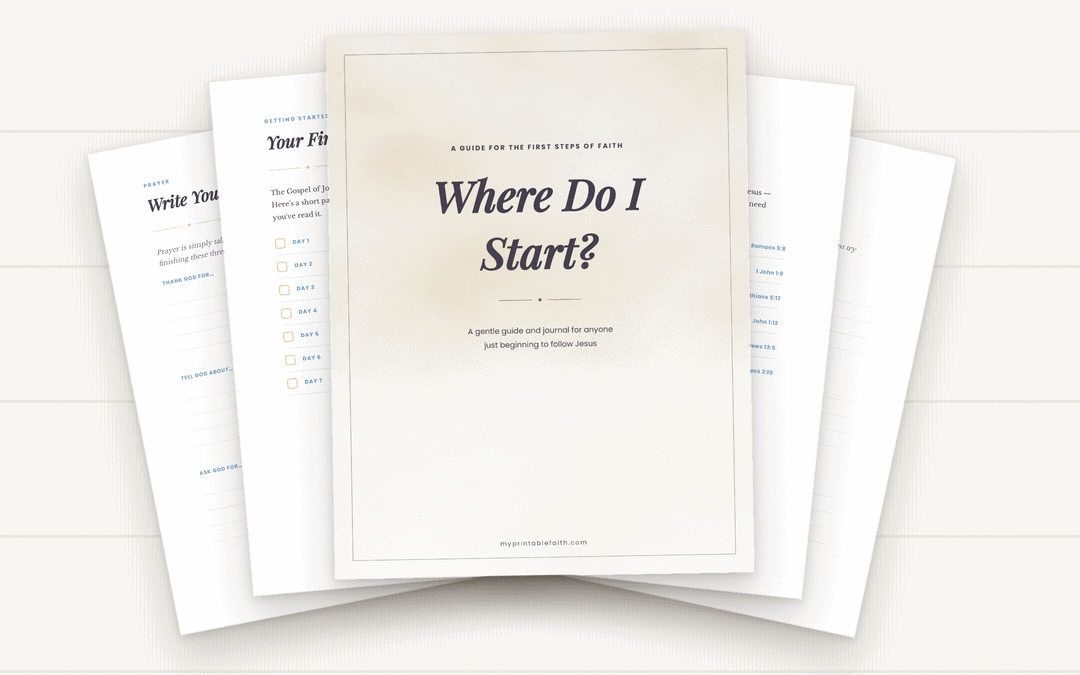
Meet Where Do I Start?
This is a gentle guide and journal for anyone just beginning to follow Jesus — whether that’s a decision made yesterday or one still being turned over. It’s not trying to teach you everything at once. It covers the basics simply, gives you one small first reading plan, and leaves plenty of room for you to write your own questions and your own story as it unfolds.
It’s also genuinely useful if you’re the one walking alongside someone new to faith — a parent, a mentor, a small group leader, a friend who just doesn’t know quite what to hand them. This is something you could give them, or work through together.
What’s Inside
- Four short pages on the basics — what it means to follow Jesus, why the Bible matters, why prayer matters, and why community matters — each with one verse to anchor it
- A simple “who you are now” page — six truths that become true the moment someone chooses to follow Jesus, whether or not they feel true yet
- A seven-day reading plan through the Gospel of John, with a box to check off each day
- A guided “write your first prayer” page, broken into three easy starting points
- Two reflection pages — one for questions still being worked through, one for writing out a faith story so far
- A practical page to write down people to turn to with questions
- A closing page of encouragement
How to Use It
There’s genuinely no wrong order here. If someone’s feeling overwhelmed, I’d actually suggest starting with the “Who You Are Now” page before anything else — it’s short, it’s encouraging, and it sets a tone of belovedness before anything else is explained. From there, the four basics pages can be read in any order, a page at a time, whenever there’s a spare five minutes.
The reading plan is meant to be slow. One short passage a day is genuinely enough — this isn’t about covering ground quickly, it’s about building the habit of actually opening a Bible regularly, which matters far more early on than how much gets read in one sitting.
The journal pages are there for whenever something comes up. A new believer’s first weeks and months are usually full of questions — some exciting, some confusing, some a little uncomfortable — and having somewhere to actually write them down, without needing to have the answer yet, takes some of the pressure off.

Why I Wanted to Make This
I think it’s easy, once you’ve been a Christian for a while, to forget how disorienting it can feel at the start. There’s a temptation to hand a new believer either too much (a dense study Bible and a reading plan through the whole Old Testament) or too little (just a “welcome, glad you’re here” and nothing practical to actually do next). I wanted something in between — enough structure to feel like a real starting point, without so much that it feels like homework.
I also think there’s something powerful about a new believer having their own words on the page early on — their own first prayer, their own first attempt at describing how they got here. Those pages tend to matter more later than they seem to in the moment.
A Couple of Practical Notes
If you’re helping disciple someone new to faith, this works well as something you go through together over coffee or a phone call, a page or two at a time, rather than just handing it over to complete alone. The conversation that happens around the pages is often just as valuable as the pages themselves.
And if you’re the new believer reading this yourself: you don’t need to finish this in a week, or even a few months. Come back to it whenever it’s useful, skip what doesn’t apply yet, and don’t worry about doing it “right.” There isn’t a right way — just a real one.
Grab Your Free Copy
Where Do I Start? is completely free to download and print at home. Regular printer paper works perfectly well for this one, though feel free to print it however suits you best if you’re planning to give it as a gift to someone.


