The Bible is an amazing book, and there are so many truths and promises in it that we can learn from.
But studying the Bible can be quite daunting. How do I do it? Where do I start?
The topical approach to studying can be a great way to get into God’s Word.
You choose the topic you want to study, learn what it means, whether it’s a word, or a phrase, and explore how it is weaved throughout the entire Word of God. It can be a broad way of studying a particular theme or word, as an overview, or, you can go more deeply into the subject.
For example, if you chose ‘Grace’ as your topic you would learn what God’s grace means and how God extends His grace throughout the Bible. You would be able to follow the topic through to see how God’s grace was there from the beginning, from the Garden of Eden, through the history of the Children of Israel, through to Christ’s coming, and the birth and early years of the church.
It’s always a great place to start with prayer. Firstly, to pray and ask the Lord what topic He would like to teach you, and then before each study spend a little time in prayer asking the Lord to show you His truth and what He wants to reveal to you along the way. I like to pray Psalm 119:18, “Open my eyes, that I may see wondrous things out of your law”.
Choose a Topic
Prayerfully choose your topic. The Bible is a never ending resource and there are so many topics you can choose. The topic could be a word, or a phrase, or even a person. You may want to follow a theme that your pastor is speaking on at church, or in Bible Study, or it may be something more personal, like an issue you are struggling with, such as anxiety or fear.
Look Up References
Start looking up, and writing down, references for your topic. You can use a Bible concordance or Bible dictionary to help you. There are plenty of online references you can use also, just type your word or phrase into the search engine and see what comes up.
You will most likely have a very long list by this stage so once you have your list sort through which of the verses you want to use for your study
Read and Observe
Now you have your verses it’s time to start your study.
You don’t need to rush through the process.
You may want to complete the study in an allocated time, such as a morning or an afternoon, or, alternatively, you may want to take longer with it, working your way through one verse or one passage at a time, using a different one each day as part of your quiet time or devotional time so you can really allow God’s Word to soak into you over a period of time.
As you read make observations, ask questions, look for principles.
Ask who, what, when, where and why of the verses.
What is the main point of the passage?
What does the passage tell me about God/myself?
Are there any instructions in the passage?
Write down your answers and observations.
Conclude and Apply
James 1:22 instructs us to be doers of the Word not just hearers.
Once you have read the passage of Scripture, asked yourself questions about it, and made some observations it’s then time to make it personal.
We rob ourselves if we approach Scripture from a purely academic level and not make it personal and allow it to transform our lives.
What is God saying to you, what is He teaching you through these verses? Is there a truth about God that you have learned? Is there an action He wants you to take? Is there something He wants you to change?
This part can take a little time as you reflect, and pray, and ask God to show you the truth of what He wants to teach you.
It’s a good idea to write down your application, it helps to clarify your thoughts and any actions you wish to take, and it also serves as a prompt and a reminder as you reflect back later.
Share What You Have Learned
Not everyone is comfortable with this, but it can be a great thing to share with a friend, a partner, or even on social media, the lessons God is teaching you. It’s not only good for you, to reinforce those lessons, but it can be an encouragement to others.
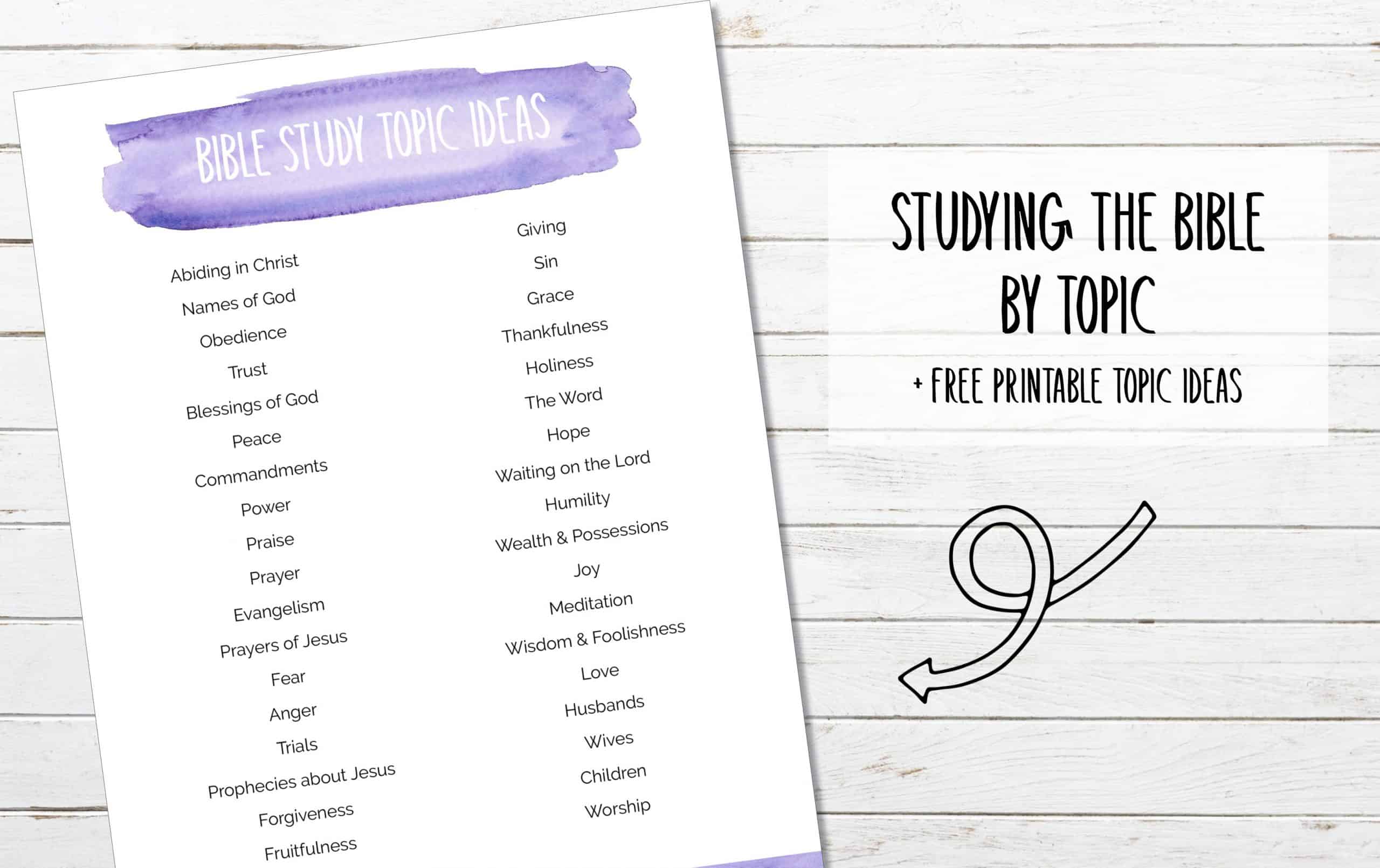
Some Suggested Topics for Study
Abiding in Christ
Names of God
Obedience
Trust
Blessings of God
Peace
Commandments
Power
Praise
Prayer
Evangelism
Prayers of Jesus
Fear
Anger
Trials
Prophecies about Jesus
Forgiveness
Fruitfulness
Righteousness
Giving
Sin
Grace
Thankfulness
Holiness
The Word
Hope
Waiting on the Lord
Humility
Wealth & Possessions
Joy
Meditation
Wisdom & Foolishness
Love
Husbands
Wives
Children
Worship
It’s an exciting journey as you start delving into Scripture, and God never ceases to surprise and amaze me at what He teaches me.
Have you tried Scripture Journaling? It’s as a great way to study God’s Word and to do a Topical Bible Study.
The SOAP method is also a good one to use for Bible study and devotional times.
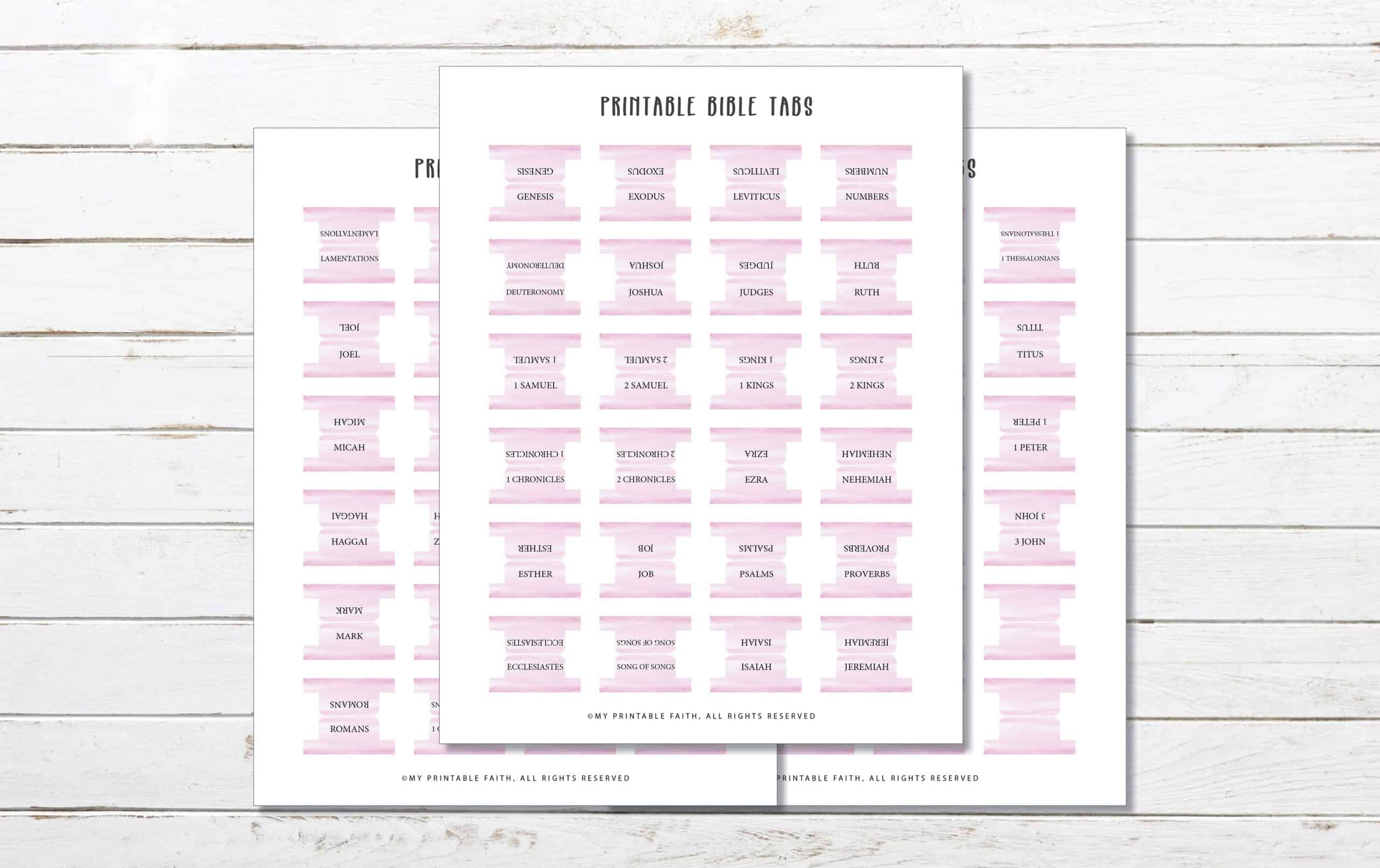
Bible divider tabs make a great addition to your bible. They help you keep tabs on where all the books are and divide it up in an easy way to navigate.
They act like the index in the front, except you don’t need to go searching for the index, its right there in front of you!
They can be good not just for those starting out but for long time readers of God’s Word to help you look things up quickly, and well lets be honest they add a little bit of pretty to your bible 😉
You might be wondering how do I put on the bible tabs? Well, I’ve made it nice and easy for you to get started by giving you a free printable you can download and instructions below on how to get your bible set up with them.
How to make bible tabs
Step 1 – Print out the bible tabs
Step 2 – Cut them out
Step 3 – Fold them in half
Step 4 – Work out the positioning of the tabs. I like to overlap them slightly, as there is space behind them you can still easily see where the names are.
Step 5 – Paste them in. You can just use regular glue or you can use sticky photo tape.
Step 6 – You’re done!
I have made some free bible tab printables for you to download below, enjoy!
No matter how good the sermon is, we all know how easy it is to get distracted, or for our thoughts to drift off to the cares of the day or the week.
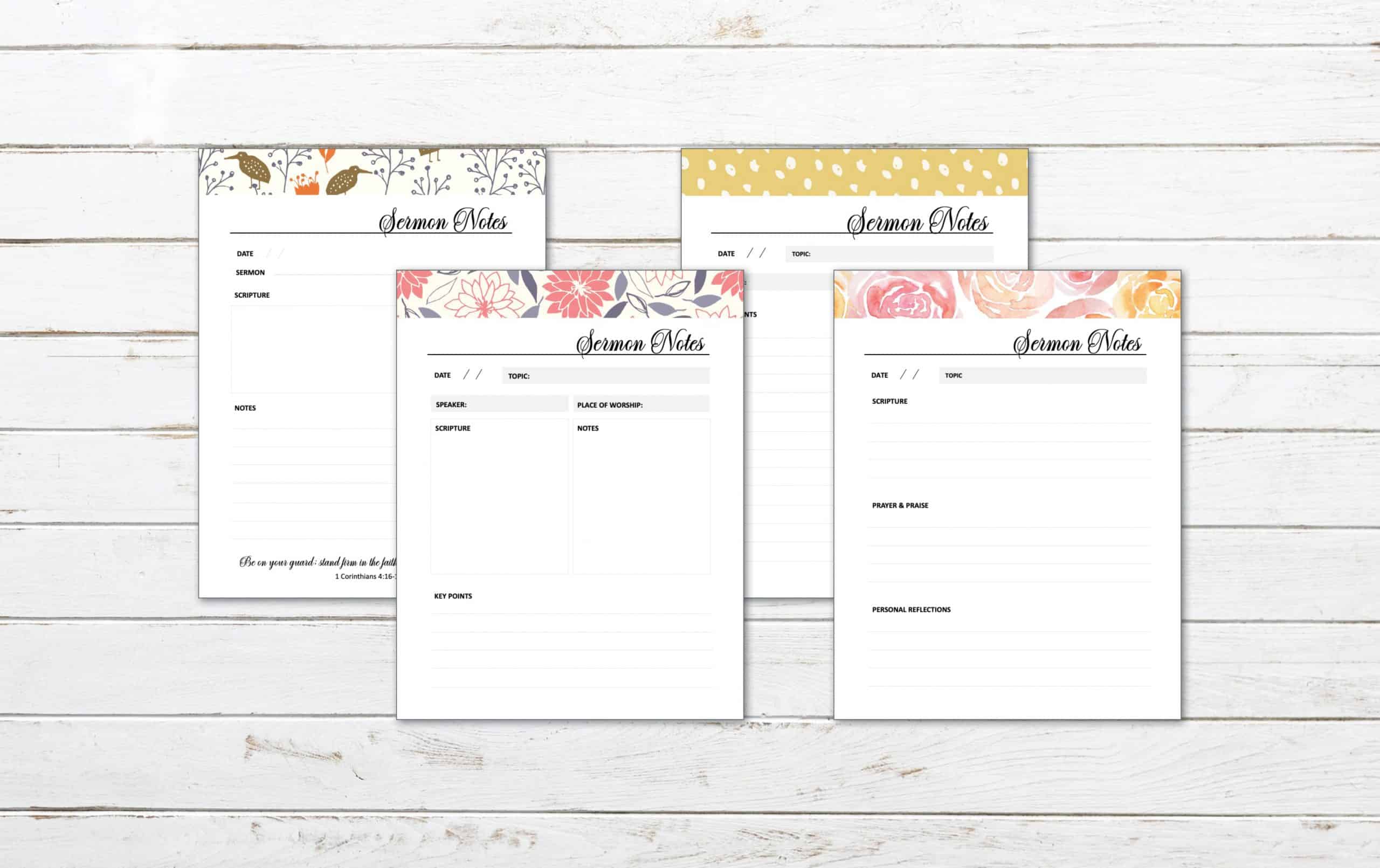
These Printable Sermon Notes Pages are a great tool to help to stay focussed while listening to the sermon.
Writing things down not only helps us to stay focussed but it enables us to think more deeply about what is being said, and helps us to remember, not just what was said, but also the lessons learned.
With 4 different designs to choose from why not add a little creativity to you note taking.
These pretty pink and gray floral design Printable Sermon Notes Pages are a great tool to help to stay focussed while listening to the sermon, enabling you to think more deeply about what is being said and to keep a record of the things God is speaking to you about.
This pink and gold floral design Sermon Notes are a great way to record your insights and thoughts each week as you listen to the sermon.
Taking notes on these sermon pages can help you stay focussed and think more deeply about what is being said. I love the cute twigs and bird design on this printable.
It’s helpful to keep notes for future reference and reflection. Using these printables can help you remember what you have learned and reflect on important thoughts from the sermon. This simple yellow spot pattern is bright and cheerful.
Praying out loud can be an intimidating thing, regardless of whether you’re a kid or an adult. Even the most outgoing child can feel self-conscious about it.
Kids need a space where they can feel safe and loved, and not vulnerable, as we encourage them to open up to God in prayer.
So how can we encourage our kids to pray, and to pray out loud with us, and with others?
As we nurture them in their growing walk with God, we want them to know they can talk to God anywhere, anytime, about anything they want to, and that with God they are safe, loved and protected.
Which leads us to prayer prompts for kids.
WHAT ARE THEY
Prayer prompts are, as they sound, prompts for prayer.
Sometimes not knowing what to pray for can be the thing that holds them back.
Prayer prompts are visual queues to help children with ideas of what to pray for.
It could be a list of prayer points, a calendar with different prayer points for each day, older kids may like to start a prayer journal, or it could be a collection of prayer ideas printed on paper or discs that they can choose from a box.
Whichever form you want to use, depending on the children’s ages, get them involved in making the prayer prompts and choosing the topics, that way they will feel more ownership of the project and more likely to pray for the things they have nominated.
HOW DO THEY WORK
Prayer prompts will encourage children to pray and to know what they can pray for, without feeling any pressure to think of something on the spot.
If you are using a calendar idea, you may have one or two suggested prayer topics on any given day. It could be that you have a different category to pray for depending on the day, or the week of the month. For example, Monday could be for missionaries, Tuesday could be for family, Wednesday could be for worship, Thursday could be things to thank God for, and so on.
If you are using printed squares, or discs which they can choose from a box you may have categories mixed together, or you may choose to separate out the categories. Each child will get to choose one or two things to pray for.
You can write them as a single word, such as ‘thanksgiving’ and the children can make up their own prayer, or, a phrase such as ‘thank you God for…my comfy bed’, or, especially for younger children, you may want to write out a prayer in full for them.
You can also use scripture verses as prayers, especially for thanksgiving and worship. The Psalms are full of wonderful verses of praise.
WHAT CATEGORIES
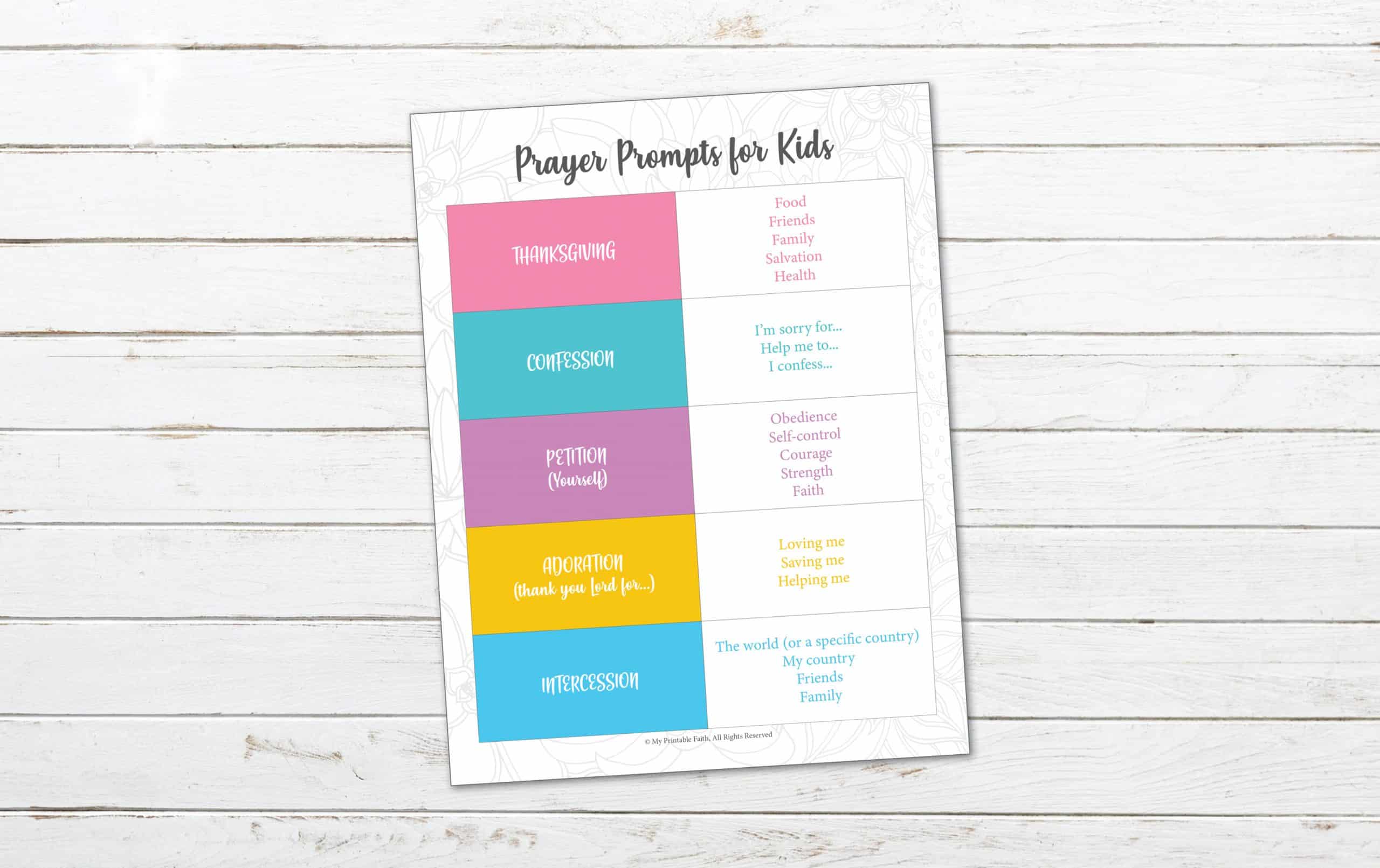
You can also break the prompts into categories using the 5 Types of Prayer.
This is a great way to teach them that prayer isn’t just about asking God for things for themselves (petition) but prayer is also about confession, adoration, thanksgiving and intercession for other people. You could have five boxes with a different category in each box and the children can pray a prompt from each one, developing a more comprehensive approach to prayer.
HOW TO MAKE PRAYER PROMPTS FOR KIDS
You can design and make your prayer prompts using paper, cardboard, tokens, or, using a calendar. Write out your prayers and prompts and decorate them using, pencils, highlighters and stickers, and anything else you can use to make them look attractive and fun.
Or, you can download these free printable prayer prompts.
SOME SUGGESTED PRAYER PROMPTS
Thanksgiving
Food
Friends
Family
Salvation
Health
Confession
I’m sorry for…
Help me to…
I confess…
Petition (Yourself)
Obedience
Self-control
Courage
Strength
Faith
Adoration
Loving me
Saving me
Helping me
Intercession
The World (or a specific country)
My Country
Friends
Family
Praying together will not only strengthen you as a family but it will grow your faith and spiritual relationship with each other and create deeper bonds of trust and intimacy amongst you.
For where two or three are gathered together in my name, there I am in the middle of them.” Matthew 18:20
Scripture journaling is not the same as keeping a diary, it is not keeping a log of facts and events of the day and is not just about a record of your feelings and thoughts.
It is a way of integrating Scripture with your thoughts and feelings, ideas and goals, and your experiences in a way that can enrich, not just your journaling but also your experience of Scripture, allowing it to have a deeper impact in your life.
There are many benefits to journaling in general. It helps with organising your thoughts, recording your ideas, helps with goal setting, relieves stress, allows for self-reflection, inspires creativity, to name a few.
So why should I do Scripture journaling and not just regular journaling?
Scripture journaling is a process that can slow us down from the busyness of our lives to take some time of reflection on Scripture and how it relates to ourselves and our lives. It can be an enriching experience that nurtures us spiritually as well as emotionally and mentally.
It will take your experience of reading the Scriptures to a whole new level.
It will also act as a record of your journey in your relationship with God that you can go back to at any time, reflect on, give thanks for, and be encouraged by as you see how God has been working in your life.
To get started all you need is the Scriptures, a book to journal in, a pen, and, if you feel creative, some coloured pencils, stickers, highlighters, paints, and anything else you may want to use to express yourself with.
It may seem a daunting thing to do, and you may not know where to begin, so here are 5 simple steps to help you work through as you begin your Scripture journaling journey.
Step 1 – Pray
Start with praying and asking God to reveal Himself to you, to guide, lead and teach you through His Word. Your prayer could be Psalm 119:18 “Open my eyes that I may see wondrous things out of Your law’.
Step 2 – Read the Scripture
As you read through the Scripture think about the words, look up words you may not understand, use the footnotes and cross-references, and any other resources you may have to help you understand what you are reading and it’s context.
Step 3 – Ponder
Take some time to ponder on what you have read, what is it saying about God, about you, and about how it might apply to your life.
Step 4 – Write
Begin writing. You may write out a verse, or some key words or phrases that stand out to you. You can highlight and circle words that stand out to you. You might use cursive writing for some words or phrases or use different styles of lettering and sizes to emphasise things.
If you feel like being a little more creative you can draw a picture or design that reflects what you have read, or how it makes you feel. You can be as creative as you want to be with this, use whatever medium you wish, stickers, paints, whatever you want. This is about your personal expression of the Scriptures, it doesn’t matter what it looks like, this is your expression.
You may even want to write a poem or a prayer to express yourself.
Step 5 – Reflect
Take a moment now to look at what you have read and what you have written and created. Reflect on what you have learned and thank God for it. There may be a special verse that you commit to memory and reflect on throughout the day.
As you practice Scripture Journaling you will develop your own unique style which will be personal to you.
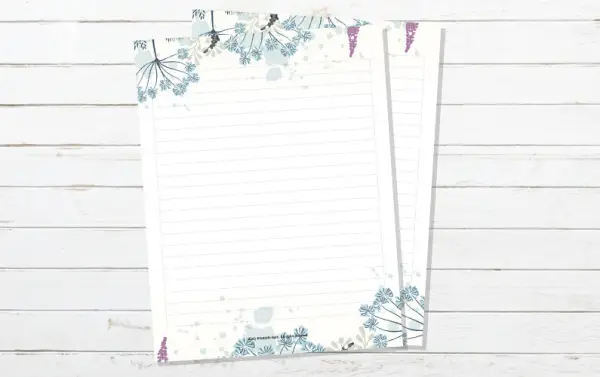
You can download a FREE scripture journaling page below to get you started.
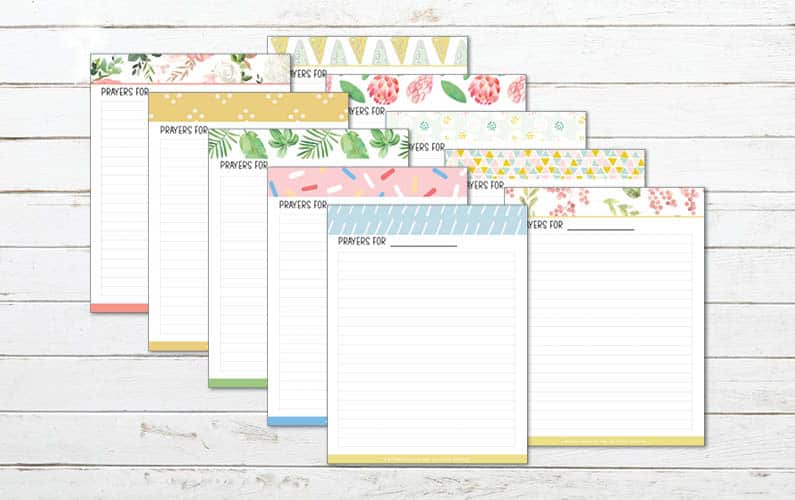
There are so many needs in the world and in our own lives that we can pray for. Sometimes though its hard to keep track of them all. It great to ave somewhere to write them down, so not only can you keep track of them all, but you can also keep track of the ones that have been answered.
I have created a “To pray for” page you can print out and use to keep track of it all. There are lots of different patterns to choose from, and you can even use a different pattern for different things your praying for.
Some ideas of things to pray for are:
Family
Husband
Wife
Children
Marriage
World – or a specific country
Health
Things your thankful for
Things your asking for
Emotions
Decisions
Finances
I hope this helps you!
Just click on an image below to open and download.
Hi, I'm Steph! I want to equip you with faith resources to encourage a love of Gods word in your life.
DISCLAIMER
Some of the links on this website are affiliate links of which My Printable Faith receives a small commission from sales of certain items, but the price is the same for you. As an Amazon Associate I earn from qualifying purchases.
TERMS OF USE
All our printables are for personal or free ministry use only.
If you wish to share our printables on your website, you may do so with a do-follow backlink to the blog page and credit. You may not share the files or images directly on your site.